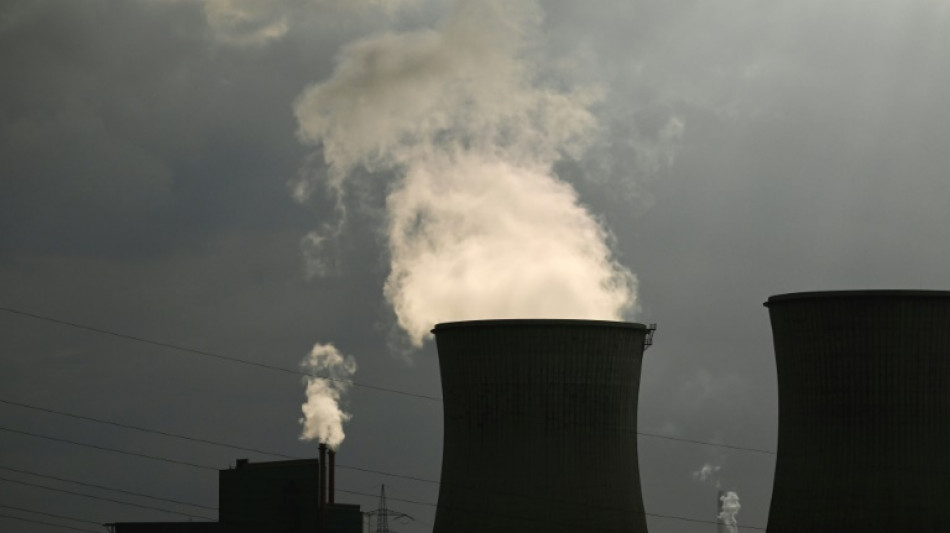
Germany raises growth forecasts, but warns reforms needed / Photo: Ina FASSBENDER - AFP

 All Blacks knew Nonu would perform solo Haka - coach Rennie

 Britain's Glave upstages Jacobs to win European 100m gold

 Greece's Tentoglou wins fourth European long jump title

 Doctors ignored 'warning signs' before Maradona's death, court hears

 Pereira, the 'zombie city' devastated by Colombia's earthquake

 UN says 2 staff arrested by Afghan intelligence agency
 Colombia scrambles to find survivors as quake kills 240

 Ramsay-Peaty out of medals as Italy's Martinenghi wins European gold

 AI firm Manus to resume 'independent' operations after China blocks Meta deal

 Caught between great powers: the cautionary tale of Manus

 Heatwave hits evicted families sleeping rough in Rome

 US company stokes Greenland tensions by unloading drilling gear

 Cambridge academic in plagiarism row publishes memoir

 LeBron's Sixers hope to spoil Knicks party on NBA opening night

 UK 'on course' to record warmest summer for second year in a row

 Spotify to launch badge identifying AI music

 New plastic treaty document criticised for weaker ambition

 Hungary parliament approves Orban-critic judge as president

 Ebola outbreak in DR Congo kills more than 2,000

 ChargeAfter Powers BYLD Finance Expansion into Consumer Financing for Equipment Retailers

 MEXC Upgrades RealStocks With Three New Features to Enhance U.S. Stock Trading Experience

 Israel demolishes home of slain Palestinian involved in deadly West Bank clash

 Liverpool fans seek clarity on Bezos bid to buy stake

 Solar eclipse sparks scramble for protective glasses across Europe

 Oil prices jump as US-Iran deal hopes falter

Germany's economy will eke out meagre growth in 2025 before picking up speed next year, the government Wednesday said as it raised forecasts, but called for "decisive reforms" for a sustained recovery.
Europe's top economy shrank in both 2024 and 2023 as it was hit by a manufacturing slump, surging energy costs and weak demand for its exports, particularly from key market China.
In its latest forecasts, the economy ministry said it did not expect a third year of recession in 2025, although the economy would only grow 0.2 percent. This was up from a forecast of stagnation in April.
Next year it expects growth of 1.3 percent, up from a previous forecast of one percent, with a spending blitz on defence and infrastructure championed by Chancellor Friedrich Merz set to provide a boost.
In 2027 the economy is expected to expand 1.4 percent.
But Economy Minister Katherina Reiche warned the government would have to "fight" to revive the economy in the long term as it battles strengthening headwinds, from volatile US trade policy to China's emergence as a rival in numerous industries.
"The economy is far from running smoothly," she told a press conference in Berlin.
"We must fight to return to growth. And we must fight to keep Europe strong. So we need the courage to implement decisive reforms."
Much of the growth momentum in 2026 and 2027 would come from a special fund set up to overhaul infrastructure and extra spending on defence, said Reiche.
Merz has moved to loosen Germany's tough debt rules to allow greater borrowing to overhaul creaking trains and crumbling bridges, and more spending on the military in the face of a growing Russian threat.
However, Reiche noted that deeper reforms were needed to "overcome structural weakness".
Her comments echoed criticism from economists that reforms are needed to deal with deep-rooted problems, such as onerous bureaucracy, to help the economy in the long term.
- China, from market to rival -
Data released earlier Wednesday highlighted the problems -- industrial production dropped sharply in August, particularly in the crisis-hit automotive sector.
Following a contraction in GDP of 0.3 percent in the second quarter, these figures show "that the risk of yet another quarter of contraction and thus an outright technical recession is very real", said economist Carsten Brzeski of ING bank.
US President Donald Trump's tariff blitz has hit Germany hard, as the United States is a major destination for the country's exporters.
A rush to stock up on imports before the tariffs kicked in gave the German economy a boost at the start of the year -- but that trend has since reversed, with the levies acting as a drag.
Foreign trade, which has been a key support for the economy in recent years, was unlikely to provide the same sort of momentum going forward, said Reiche.
This was due not only to volatile US trade policy, but also because China had become a rival to Germany in many industries, rather than simply a destination for its exports.
"China has become a serious competitor to Germany in such important transformation industries as photovoltaics, batteries, and even wind energy," said Reiche.
B.Godinho--PC