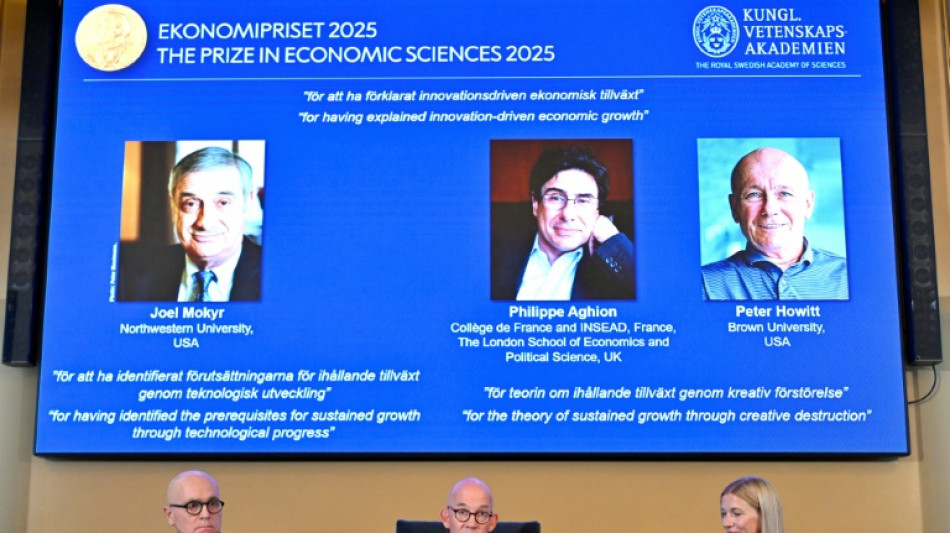
Nobel economist warns of AI dangers / Photo: Anders WIKLUND - TT NEWS AGENCY/AFP

 Trump's secret plane swap triggers questions and confusion

 California calls Paramount's threat to leave state 'blackmail'

 PSG 'want to win everything', says Luis Enrique

 Barred from elections, Russia's anti-war party vows to fight on

 Jaissle states Newcastle ambition but urges patience

 NBA star Cooper Flagg trading card a slam dunk for lucky buyer

 ForumPay Expands Payment Infrastructure with New Card and Bank Transfer Acceptance Solution
 Oil prices higher, stocks flat ahead of inflation report
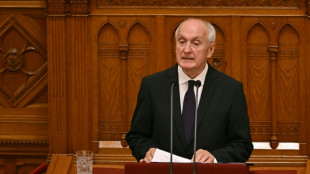 Orban-critic ex-judge becomes Hungary president after predecessor ouster

 US rights groups sue Trump over ICC sanctions

 Sphere 3D Corp. (Nasdaq: ANY) Attracts 6.5% Stake from Turnaround Bitcoin-Mining Investor
 Oil prices lower, stocks higher as Hormuz doubts drag on
 Colombia scrambles to find survivors as quake kills 181

 Colombia scrambles to find survivors as quake kills 169

 MEXC Report: 74.2% of Traditional Finance Users Have Shifted Their Trading Activity to Crypto Exchanges

 MEXC Lists DAPPOS (DOS) With $60,000 Worth of DOS and 10,000 USDT in Airdrop+ Rewards

 Jellyfish force shutdown of three reactors at French nuclear plant
 Hodgkinson, Werro sail through Euro 800m qualifying
 Somali referee denied World Cup 'proud' to oversee UEFA Super Cup

 French newspapers target Google over AI summaries

 Ebola death toll in DR Congo outbreak rises to more than 2,000

 PrimeXBT Launches MT5 Cent Account for Beginners and Risk-Conscious Traders

 British sprinter Hunt chasing three more golds after winning 100m

 Ethiopia's Tigray rebel authorities condemn army drone strikes
 Too hot to live? French buyers rethink housing choices after heatwaves

A winner of this year’s Nobel prize in economics warned Monday that artificial intelligence offers "amazing possibilities" but should be regulated because of its job-destroying potential.
The remarks from Canadian Peter Howitt, professor emeritus at Brown University in the United States, came amid growing concerns about how AI will impact society and the labor market.
California Governor Gavin Newsom on Monday signed a first-of-its-kind law regulating interactions with AI chatbots, defying a push from the White House to leave the technology unchecked.
Howitt was one of three economists honored Monday by the Royal Swedish Academy of Sciences for work on how technology drives and affects growth.
His research with fellow winner Philippe Aghion of France focused on the theory of "creative destruction" in which a new and better product enters the market, and the companies selling the older products lose out.
Howitt told a news conference that it remains to be seen who will be the leader in AI, and "we don't know what the creative destruction effects are going to be."
"It's obviously a fantastic technology that has amazing possibilities. And it also obviously has an amazing potential for destroying other jobs or replacing highly skilled labor. And all I can say is that this is a conflict. It's going to have to be regulated," he said.
"Private incentives in an unregulated market are not really going to resolve this conflict in a way that's best for society, and we don't know what's going to come from it."
Howitt, 79, said it was a "big moment in human history" and likened it to past periods of technological innovation, including the telecoms boom of the 1990s, and the dawns of electricity and steam power.
He said those innovations all demonstrated how technology can enhance and not just replace labor. "How we're going to do it this time? I wish I had specific answers, but I don't," he added.
Howitt said that when he and Aghion first wrote their seminal 1992 paper on creative destruction it took five years to get it published, but his collaborator knew they were on to something special.
"Right from the beginning, from our very first research, I remember back in 1987, Philippe saying we're going to get a Nobel Prize for this. I said, 'Sure, sure, sure,'" Howitt recalled.
"He said, 'Our time will come. Our time will come,' okay, and now it’s come. Amazing."
X.M.Francisco--PC