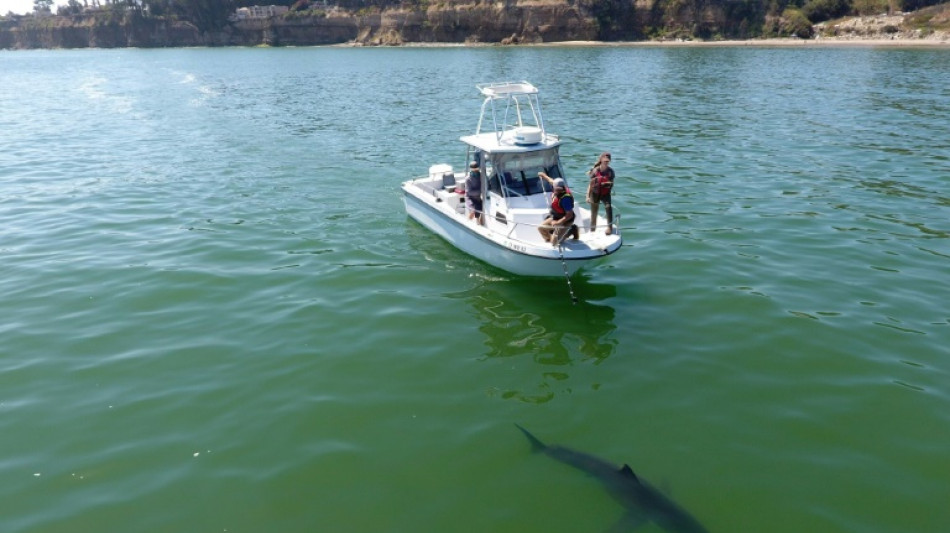
Climate change draws great white sharks north, threatening ecosystem / Photo: Eric MAILANDER - UGC/AFP

 Indonesia accepts Malaysia's help to tackle wildfires

 Indians living in Japan on stand-by to house Asian Games athletes

 Trump signs bill authorizing sweeping Russia sanctions

 Protesters form human chain at Kennedy Center after Trump threat

 Death toll from attack at police HQ in Pakistan rises to 31

 Trump says Denmark to give US 'permanent control' over Greenland security

 Kennedy Center: future unclear for iconic Washington arts hub

 Trump claims 'infinite' Greenland security deal with Denmark

 Helicopters battle wildfire threatening Ecuador's capital

 Brentford batter Chelsea to undo Alonso's promising start

 Kane hits Bundesliga century as Bayern rout Union

 Trump says CNN, MS NOW, Politico banned from White House

 Hushing and hedging: US companies retreat on climate

 Springboks to face Fiji before 2027 Rugby World Cup

 Nigeria miners struggled to breathe in cell before 37 died: survivors

 McIlroy on the charge at PGA Championship as Reed withdraws

 McIlroy on the charge at PGA Championship

 Crisis-wracked Volkswagen warns of 10-bn-euro hit to profits

 Costa Rica's Grynspan tops third informal poll for UN chief: diplomat

 Stock markets retreat after central bank rate hikes

 Russia labels director of Cannes Grand Prix winner a 'foreign agent'

 Macron warns of Russian 'hybrid' threat after meeting presidential hopefuls

 UN holds third informal poll for new chief

 Kulusevski return can spark Spurs: De Zerbi

 Shakira to cap off world tour with Madrid 12-gig run

There never used to be young great white sharks basking off the busy beaches of central California, but as climate change starts to bite, warmer waters are enticing them north -- with possibly catastrophic consequences for a whole ecosystem.
Despite their fearsome reputation, brought about in part by the "Jaws" movie franchise, the main risk from these predators is not to swimmers and surfers -- or even the local police chief -- but to otters.
"What we've been finding is that over time the number of bites on sea otters has increased in this region drastically," says marine ecologist Salvador Jorgensen of California State University Monterey Bay.
"That's having a real impact on the sea otter population."
And -- in an illustation of how interconnected ecosystems are -- that could have far-reaching consequences for all kinds of species in this wildlife-rich area.
- Warm water -
Great white sharks are some of the most majestic, most studied, and most feared of ocean dwellers.
Growing to around 16 feet (4.9 meters), they roam the world's seas thousands of feet deep to satisfy a voracious appetite for seals, sea lions and dolphins.
They live for upwards of 70 years and give birth to litters of live pups, who are left to fend for themselves from an early age.
But because white sharks are endotherms -- warm-bodied, like mammals -- youngsters are vulnerable to the cold of the ocean depths, and spend their time in warmer pockets of water in coastal regions.
Until a decade or so ago, that meant juveniles would only be found as far north as southern California.
But, says Jorgensen, that's changing.
"We documented the sudden occurrence of much smaller sharks than had ever been seen here before," he told AFP in Monterey Bay, hundreds of miles (kilometers) north, where he attaches acoustic transmitters to individuals that allow him to track their travels.
"As ocean temperatures have been warming through a series of El Ninos, and heat waves, many species have been shifting their range further north further towards what were historically cooler areas."
That's what brings them into contact with sea otters, who hang around in the rich kelp forests offshore.
- Sea urchins -
"Smaller sharks are transitioning from eating fish and squid to a point where they're going to start eating marine mammals," says Jorgensen
"To an inexperienced shark, an otter may seem like the right target, but it turns out that otters don't have a rich blubber layer, (so) once they're bitten, they're actually not consumed. But often those interactions are fatal for the otter."
Aside from this being bad news for the individual, it's terrible news for the otter population -- setting off a cascade effect.
Otters forage for sea urchins, a species that left unchecked will graze a kelp forest into a barren desert, killing a vital marine habitat that provides food and shelter for a suite of invertebrates, fish, mammals and birds.
Without the otters, the kelp dies; without the kelp, scores of ocean species struggle.
- Climate change -
For Eric Mailander, an amateur scientist and boat skipper who helps Jorgensen tag great whites, the presence of young sharks in Monterey Bay offers a chance to see a truly impressive creature up close.
"The excitement is always there," he said.
"It's like the first time I saw a shark, it never goes away. If I go out and see a shark, I'm excited."
While the very visible presence of these enormous creatures so close to the shore can raise concerns among humans, Mailander says people don't need to be too worried -- despite the creature's reputation.
"'Jaws' scared the bejesus out of me. But I want people to know not to fear them. Just go look at them."
For Jorgensen it's a vivid illustration of just how rapidly we are altering our planet, with the unchecked burning of fossil fuels.
"I've always thought that this is a very tangible way that people can understand climate change," says Jorgensen.
"People who live on that beach, bring their children there, never had a bunch of sharks swimming 20 feet away, and now it's a regular sight.
"You can't look out at the ocean and think that climate change is not happening."
V.Dantas--PC



