
-
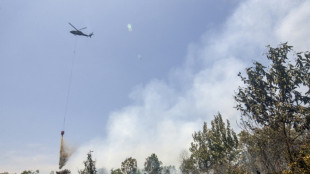 Indonesia accepts Malaysia's help to tackle wildfires
-
Denmark hails 'binding' Greenland deal with Trump

-
 Indians living in Japan on stand-by to house Asian Games athletes
-
We don't want Games host Japan losing money, says Asian Olympic official

-
 Trump signs bill authorizing sweeping Russia sanctions
-
Ed Sheeran returns to stage after Palestinian controversy

-
 Protesters form human chain at Kennedy Center after Trump threat
-
Asian Games to open in Japan after troubled build-up

-
 Death toll from attack at police HQ in Pakistan rises to 31
-
Drone owners rush to offload devices ahead of Beijing ban

-
 Trump says Denmark to give US 'permanent control' over Greenland security
-
Trump's beef policies irk Texas ranchers, testing their loyalty

-
 Kennedy Center: future unclear for iconic Washington arts hub
-
Nvidia, OpenAI CEOs to attend Xi dinner at White House

-
 Trump claims 'infinite' Greenland security deal with Denmark
-
Anthropic picks Accenture for in-house AI safety evaluation

-
 Helicopters battle wildfire threatening Ecuador's capital
-
Balogun returns as Monaco beat Lens to continue strong Ligue 1 start

-
 Brentford batter Chelsea to undo Alonso's promising start
-
'Pause' on overt repression in Venezuela, but reforms still needed: HRW

-
 Kane hits Bundesliga century as Bayern rout Union
-
Global stocks mixed as yen falls despite Bank of Japan rate hike

-
 Trump says CNN, MS NOW, Politico banned from White House
-
Cuba hit with seventh major blackout of the year

-
 Hushing and hedging: US companies retreat on climate
-
Murray out with concussion so Wentz will start for Vikings

-
 Springboks to face Fiji before 2027 Rugby World Cup
-
UN chief 'deeply regrets' US visa refusal to Abbas for annual meeting

-
 Nigeria miners struggled to breathe in cell before 37 died: survivors
-
England quick Carse to face no charges over alleged nightclub assault

-
 McIlroy on the charge at PGA Championship as Reed withdraws
-
Mancini brings nine newcomers into the first squad of his Italy comeback

-
 McIlroy on the charge at PGA Championship
-
Czechs level Davis Cup tie against USA as South Korea eye Finals

-
 Crisis-wracked Volkswagen warns of 10-bn-euro hit to profits
-
New France boss Zidane confirms Mbappe as captain after naming first squad

-
 Costa Rica's Grynspan tops third informal poll for UN chief: diplomat
-
California governor signs order to explore AI 'kill switch'

-
 Stock markets retreat after central bank rate hikes
-
Head leads run spree as Australia win Zimbabwe ODI series

-
 Russia labels director of Cannes Grand Prix winner a 'foreign agent'
-
In-form Raphinha wants to finish career at Barcelona

-
 Macron warns of Russian 'hybrid' threat after meeting presidential hopefuls
-
Warren Buffett steps down as Berkshire Hathaway chairman

-
 UN holds third informal poll for new chief
-
Carrick confident Man Utd can 'work through' tough time

-
 Kulusevski return can spark Spurs: De Zerbi
-
Mbappe ends Nike partnership to join Swiss brand On

-
 Shakira to cap off world tour with Madrid 12-gig run
-
Liverpool boss Iraola puts Bournemouth love affair on hold

Five killed by India glacial lake burst flood, 23 soldiers missing
At least five people have been killed and dozens including 23 soldiers are missing in India after intense rains burst a glacial lake and triggered a torrential flash flood, officials said Wednesday.
Violent flooding from glacier lakes dammed by loose rock has become more frequent as global temperatures rise and ice melts, with scientists on Wednesday warning the deadly flood was a taste of further extreme weather events to come.
A video released by an Indian army spokesman showed a thick torrent of raging brown water sweeping down a densely forested valley in mountainous northeast Sikkim state, with roads washed away and power lines ripped down.
"Due to sudden cloud burst over Lhonak Lake in North Sikkim, a flash flood occurred in the Teesta River... 23 personnel have been reported missing and some vehicles are reported submerged under the slush," the army said in a statement. "Search operations are underway."
The Sikkim state government said at least five people had been reported killed, with three bodies recovered.
As well as the 23 soldiers, more than a dozen civilians are missing, it said.
Sikkim is close to India's border with Nepal and China and boasts a sizeable military presence.
India has been wary of China's growing military assertiveness and their 3,500-kilometre (2,200-mile) shared frontier has been a perennial source of tension, with parts of Sikkim claimed by Beijing.
- 'Catastrophic' -
The water surge was caused by a burst of the high-altitude Lhonak Lake -- which sits at the base of a glacier in peaks surrounding the world's third-highest mountain, Kangchenjunga.
A wall of water powered downstream, adding to a river already swollen by monsoon rains, damaging a dam and sweeping houses and bridges in its path and causing "serious destruction", the government said.
Lhonak Lake had shrunk by nearly two-thirds in size overnight, an area roughly equivalent to about 150 football pitches (105 hectares), satellite photographs released by the Indian Space Research Organisation showed.
Sikkim Chief Minister Prem Singh Tamang said emergency services were working to support those impacted by the ferocious floods and urged people to "remain vigilant".
Prime Minister Narendra Modi said he "assured all possible support" for those impacted.
"Intense rain has led to this catastrophic situation in Sikkim where the rain has triggered a glacial lake outburst flood and damaged a dam, and caused loss of life", said Miriam Jackson, a scientist specialising in ice who monitors Himalayan regions.
"We observe that such extreme events increase in frequency as the climate continues to warm and takes us into unknown territory", Jackson added, in a statement from the International Centre for Integrated Mountain Development (ICIMOD) research group.
Himalayan glaciers are melting faster than ever due to climate change, exposing communities to unpredictable and costly disasters, according to the Nepal-based ICIMOD.
Earth's average surface temperature has risen nearly 1.2 degrees Celsius since preindustrial times, but high-mountain regions around the world have warmed at twice that pace, climate scientists say.
The Sikkim region is also hit annually by flash floods during the monsoon rains, which begin in June and normally withdraw from the Indian subcontinent by the end of September. By October, the heaviest of the monsoon rains are usually over.
Melting glaciers add to the volume of water while unregulated construction in flood-prone areas exacerbates the damage.
burs-pjm/dva
C.Amaral--PC



