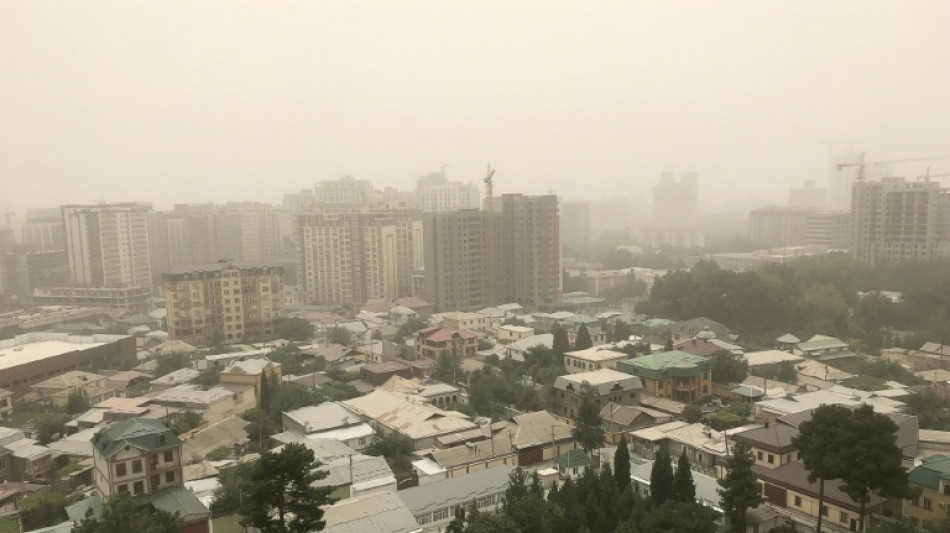
Toxic storms blamed on climate change cloud Tajikistan / Photo: Nasim ISAMOV - AFP

 Indonesia accepts Malaysia's help to tackle wildfires

 Indians living in Japan on stand-by to house Asian Games athletes

 Trump signs bill authorizing sweeping Russia sanctions

 Protesters form human chain at Kennedy Center after Trump threat

 Death toll from attack at police HQ in Pakistan rises to 31

 Trump says Denmark to give US 'permanent control' over Greenland security

 Kennedy Center: future unclear for iconic Washington arts hub

 Trump claims 'infinite' Greenland security deal with Denmark

 Helicopters battle wildfire threatening Ecuador's capital

 Brentford batter Chelsea to undo Alonso's promising start

 Kane hits Bundesliga century as Bayern rout Union

 Trump says CNN, MS NOW, Politico banned from White House

 Hushing and hedging: US companies retreat on climate

 Springboks to face Fiji before 2027 Rugby World Cup

 Nigeria miners struggled to breathe in cell before 37 died: survivors

 McIlroy on the charge at PGA Championship as Reed withdraws

 McIlroy on the charge at PGA Championship

 Crisis-wracked Volkswagen warns of 10-bn-euro hit to profits

 Costa Rica's Grynspan tops third informal poll for UN chief: diplomat

 Stock markets retreat after central bank rate hikes

 Russia labels director of Cannes Grand Prix winner a 'foreign agent'

 Macron warns of Russian 'hybrid' threat after meeting presidential hopefuls

 UN holds third informal poll for new chief

 Kulusevski return can spark Spurs: De Zerbi

 Shakira to cap off world tour with Madrid 12-gig run

The air was dry and warm and the skies over Dushanbe were grey without a hint of sun during another recent toxic sand storm that enveloped the capital of Tajikistan.
Storms like this, which experts say are being caused by climate change, are becoming increasingly frequent across Central Asia, harming its inhabitants.
The imposing mountains around Dushanbe were barely visible through the haze and hulks of apartment blocks under construction stood like ghostly apparitions.
Tajikistan was ranked one of the top 10 most polluted countries in the world in the 2022 IQAir air quality index.
"I can't stop coughing. I'm fed up with this dust choking me," Munira Khushkadamova, a teacher, said during a visit to the Sofia clinic in Dushanbe.
For the last two years, the 43-year-old has been suffering from respiratory failure -- a diagnosis given to her from her doctor Faical Sakhray.
"In the last few years I have been getting more and more patients with cardiovascular diseases," he told AFP, blaming fine particles from the storms.
"The biggest ones enter the organism and stay in the upper respiratory tract but the finer ones go into the lower respiratory tract, then the lungs, the heart and other organs," he said.
- High exposure -
The United Nations estimates that 80 percent of the Tajik population is exposed to the highest concentrations of fine particles, known as PM2.5.
Sakhray said people should drink plenty of water and wear a mask for protection.
But the number of people wearing a mask in the streets of Dushanbe is minimal.
Despite having "difficulty breathing and headaches", Nigora Yusupova said she would not wear a mask because it "makes breathing harder".
These types of storms used to be rare but they now start in spring and continue into the autumn in large parts of Central Asia.
"In the 1990s, there were two or three sand and dust storms per year in Tajikistan. Now there can be up to 35," said Zebuniso Muminzoda, head of the Tajik branch of the Regional Environmental Centre for Central Asia.
"Because of climate change, longer dry seasons lead to sand and dust storms by drying out the ground and stronger winds then pick up this dry soil," she said.
The storms often start out in the dried-out stretches of the Aral Sea in Uzbekistan but also in the Kazakh steppes and in neighbouring Afghanistan.
Muminzoda pointed to a "human factor", saying forestry, bad irrigation and year-round livestock farming were all contributing to "degrading the soil".
It is a vicious circle for a poor, mainly rural country like Tajikistan, where the toxic storms also have a negative effect on farming and soil fertility.
The sand and dust also falls on the region's many glaciers -- a crucial source of water in the region and "speeds up their melting," Muminzoda said.
While there are often tensions between Central Asian countries, they are attempting common efforts to tackle environmental questions like water management and nuclear waste disposal.
But the storm threat in Tajikistan is still under-estimated "as natural catastrophe", according to the Regional Environmental Centre, which operates in all five countries in the region.
G.M.Castelo--PC



