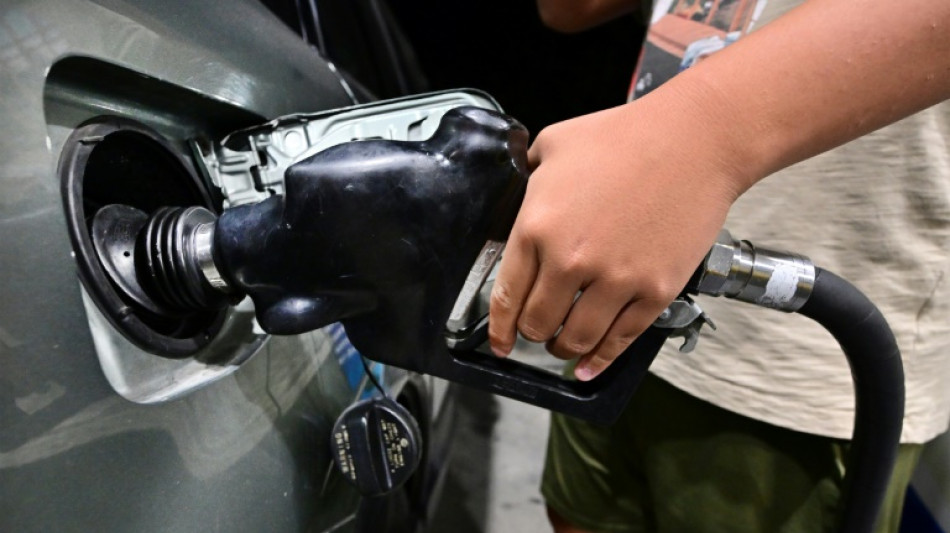
OPEC sees no peak in global oil demand on the horizon / Photo: Frederic J. BROWN - AFP/File

 Indonesia accepts Malaysia's help to tackle wildfires

 Indians living in Japan on stand-by to house Asian Games athletes
 Trump signs bill authorizing sweeping Russia sanctions

 Protesters form human chain at Kennedy Center after Trump threat

 Death toll from attack at police HQ in Pakistan rises to 31

 Trump says Denmark to give US 'permanent control' over Greenland security

 Kennedy Center: future unclear for iconic Washington arts hub

 Trump claims 'infinite' Greenland security deal with Denmark

 Helicopters battle wildfire threatening Ecuador's capital

 Brentford batter Chelsea to undo Alonso's promising start

 Kane hits Bundesliga century as Bayern rout Union

 Trump says CNN, MS NOW, Politico banned from White House

 Hushing and hedging: US companies retreat on climate

 Springboks to face Fiji before 2027 Rugby World Cup

 Nigeria miners struggled to breathe in cell before 37 died: survivors

 McIlroy on the charge at PGA Championship as Reed withdraws

 McIlroy on the charge at PGA Championship

 Crisis-wracked Volkswagen warns of 10-bn-euro hit to profits

 Costa Rica's Grynspan tops third informal poll for UN chief: diplomat

 Stock markets retreat after central bank rate hikes

 Russia labels director of Cannes Grand Prix winner a 'foreign agent'

 Macron warns of Russian 'hybrid' threat after meeting presidential hopefuls

 UN holds third informal poll for new chief

 Kulusevski return can spark Spurs: De Zerbi

 Shakira to cap off world tour with Madrid 12-gig run

Despite mounting efforts to limit climate change, the OPEC oil cartel said Monday it expects demand for crude to continue to grow for the next two decades.
In its 2023 annual report, the Organization of the Petroleum Exporting Countries forecasts demand for crude to reach 116 million barrels per day (mbd) by 2045 under its main scenario, a 16.5 percent increase from the 99.4 mbd in 2022.
That is an increase of 6 mbd from its estimate last year.
Oil demand has "the potential to be even higher", said OPEC chief Haitham Al Ghais.
"What is clear is that the world will continue to need more energy in the decades to come," he emphasised in the forward to the report -- which comes just eight weeks before the next UN climate conference, COP28, in Dubai.
At the conference dozens of countries will try to impose the adoption of the objective of an end to the use of fossil fuels like oil, natural gas and coal.
According to OPEC, whose 13 member states include Saudi Arabia, the Gulf states and Venezuela, oil demand will be driven by emerging and developing nations, with India in pole position.
Meanwhile, it sees oil demand in the OECD club of advanced economies declining from 2025.
In order to meet this demand OPEC says additional investment in fossil fuel production will be needed, putting the figure at $14 trillion by 2045, or roughly $610 billion per year.
"It is vital that these are made; it is beneficial for both producers and consumers," said Al Ghais, a Kuwaiti oil executive.
"Calls to stop investments in new oil projects are misguided and could lead to energy and economic chaos," he warned, in criticism aimed at the International Energy Agency (IEA).
In 2021, the IEA surprised the world and shocked oil exporting nations by calling for a halt in new investment in fossil fuel production to attain carbon neutrality by 2050.
- Investments 'lagging' -
The IEA, which is part of the OECD, recently confirmed that it sees no new fossil fuel projects as necessary in the long term.
Last month, it forecast for the first time that world demand for oil, gas and coal will peak this decade, and dropping by 24 mbd by 2050 due to spectacular growth of cleaner energy technologies and electric cars.
Meanwhile, OPEC says it takes a "realistic approach" in its main forecast scenario.
"What is clear is that a sustainable energy and economic future for all requires all energy sources, all relevant technologies, unprecedented investment and collaboration, and with energy security, economic development and reducing emissions going hand-in-hand," it said.
"There is no single solution to meet growing global energy needs," it added.
OPEC's view dovetails with that of the president of the upcoming COP28 climate talks, Sultan Al Jaber of OPEC-member country United Arab Emirates.
"We cannot unplug the energy system of today before we build the new system of tomorrow," he said on Sunday.
Al Jaber believes that the world needs to start with a tripling of renewable energy production before beginning the transition away from fossil fuels.
OPEC meanwhile noted that while advanced nations have set targets for expanding renewable and nuclear power to meet their energy security and sustainability goals, "these ambitious targets increasingly stand at odds with realities on the ground".
It said the required investments to achieve these targets "are significantly lagging".
OPEC elaborated two additional forecast scenarios.
One assumes fast expansion of renewables which sees global oil demand roughly stabilising at its current level for the next decade before beginning a slow decline.
The other sees countries putting a priority on economic growth, results in an increase in global oil demand of 6.3 mbd on top of the reference scenario.
OPEC also backed developing technological solutions to reduce emissions, such as carbon capture and storage. While the possibility of removing carbon from emissions appeals to industry, the technology is far from maturity.
M.Gameiro--PC



