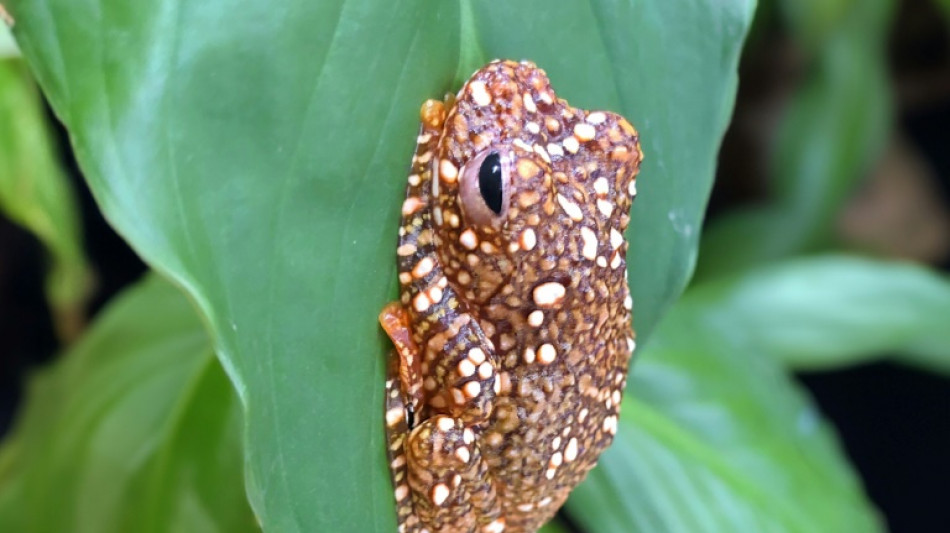
Young frogs may camouflage selves as animal poo: study / Photo: Samantha CLOER - Tiergarten Schönbrunn/AFP

 India seeks threefold increase in coal stocks to prevent summer power shortages

 Indian companies report mixed second-quarter results on November 4

 KKR secures Indian regulator approval for Gentari Renewables investment

 Bharti Airtel revenue expected to grow at double-digit pace in second quarter

 Indian crude-sensitive shares gain after 13% oil-price decline

 Stocks and dollar fall as Democratic election gains reshape markets

 Kuwait marks key events and anniversaries from national history

 Trump congratulates Democrats and signals willingness to cooperate

 Qatar prime minister advances mediation through diplomatic calls

 Greenland parliament approves security agreement with United States

 Qatar envoy meets incoming UN General Assembly president

 Trump Signals Willingness to Work With Democrats After Midterm Defeat

 Pitches and Keynote Speakers Are Confirmed for Blue Magic Netherlands on November 17
The young offspring of a frog native to Southeast Asia display an "unusual colour pattern", probably to camouflage themselves "as animal droppings" to escape predators, according to a study.
A team of researchers studying juvenile Wallace's flying frogs -- which are bright red with small white dots -- made the findings thanks to an experiment at Vienna's Schoenbrunn Zoo, the zoo said on Thursday.
"The young frogs probably count on the fact that they will be seen but considered something inedible," University of Vienna researcher Susanne Stueckler said.
She and several others recently published their findings in the journal Behavioral Ecology and Sociobiology.
To test their hypothesis that the frogs were trying to escape predators, the researchers created differently coloured wax frog models and placed them in the zoo's rainforest house.
The house "contains a diverse community of avian predators that are well known to use colour vision to detect frogs as prey", the study notes.
It found that the attack rate was significantly greater for red than for green but was reduced by half when red models had white spots.
"We show that the unusual colour pattern of juveniles likely functions as a masquerade of animal droppings," the researchers said.
"(It may) function as anti-predator strategy... so that predators misidentified them as inedible objects," they added.
"To our knowledge, this is the first experimental exploration of a vertebrate masquerading as animal droppings."
The frogs' spots disappear after one year, "when individuals mature into adults and develop their iconic emerald green colour".
Wallace's flying frogs can glide 16 metres (52 feet) from tree to tree thanks to skins between their toes and appendages on their arms and legs.
P.Serra--PC



