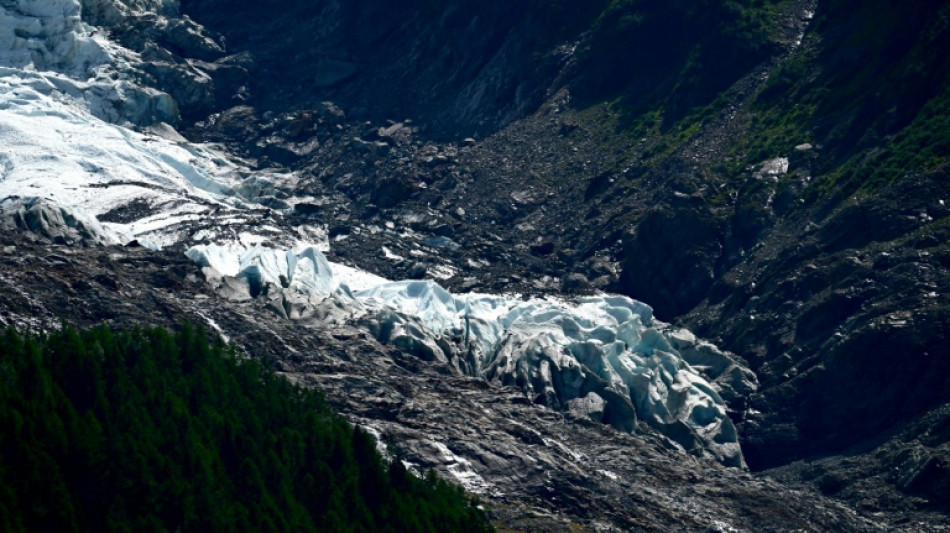
Retreating glaciers reveal new pastures for conservationists / Photo: Emmanuel DUNAND - AFP/File

 Indonesia accepts Malaysia's help to tackle wildfires

 Indians living in Japan on stand-by to house Asian Games athletes
 Trump signs bill authorizing sweeping Russia sanctions

 Protesters form human chain at Kennedy Center after Trump threat

 Death toll from attack at police HQ in Pakistan rises to 31

 Trump says Denmark to give US 'permanent control' over Greenland security

 Kennedy Center: future unclear for iconic Washington arts hub

 Trump claims 'infinite' Greenland security deal with Denmark

 Helicopters battle wildfire threatening Ecuador's capital

 Brentford batter Chelsea to undo Alonso's promising start

 Kane hits Bundesliga century as Bayern rout Union

 Trump says CNN, MS NOW, Politico banned from White House

 Hushing and hedging: US companies retreat on climate

 Springboks to face Fiji before 2027 Rugby World Cup

 Nigeria miners struggled to breathe in cell before 37 died: survivors

 McIlroy on the charge at PGA Championship as Reed withdraws

 McIlroy on the charge at PGA Championship

 Crisis-wracked Volkswagen warns of 10-bn-euro hit to profits

 Costa Rica's Grynspan tops third informal poll for UN chief: diplomat

 Stock markets retreat after central bank rate hikes

 Russia labels director of Cannes Grand Prix winner a 'foreign agent'

 Macron warns of Russian 'hybrid' threat after meeting presidential hopefuls

 UN holds third informal poll for new chief

 Kulusevski return can spark Spurs: De Zerbi

 Shakira to cap off world tour with Madrid 12-gig run

Water surged through a desolate canyon of grey rock into a blue-grey lake, an ancient landscape only revealed to humanity in recent decades because France's glaciers have retreated so far.
The rocks bore the markings of the ice and, on an unseasonably hot day in October high above the ski resort of Chamonix, experts from the Ice and Life research project were clear that their task was no longer to try to protect the glaciers.
Human-induced global heating has led to reduced winter snowfall and to summer heatwaves, which is having devastating, and mostly irreversible, effects on glaciers.
"We've melted the glaciers. We haven't managed to preserve them. But maybe we have a second chance," Jean-Baptiste Bosson, glaciologist and coordinator of Ice and Life, told AFP.
"It's now all about how we preserve the nature that emerges after the retreat. Can we create a sanctuary for this new life, a Garden of Eden?"
Even at an altitude of some 2,000 metres (6,600 feet), the glacial retreat had already made way for a lake and small pools surrounded by wild rushes.
Small, colourful flowers were gradually colonising the lake's edges.
For Bosson and his team, these landscapes could play a huge role in mitigating climate change, either by filtering water, storing carbon or promoting biodiversity.
But the team said post-glacial landscapes were largely unprotected and could soon fall prey to commercial interests like companies and tourist resorts looking to exploit mineral deposits or the available water.
- 'Nature decides' -
Since the end of the so-called Little Ice Age, a very cold period in Europe and North America from the 14th century to the 1850s, an area four times the size of Paris has emerged from under the ice in the French Alps.
And the phenomenon is global.
The Earth is home to about 210,000 glaciers and experts predict ice-free areas the size of Nepal or Finland could emerge by 2100.
Part of the uniqueness of these ecosystems is that they are completely untouched by human development.
"Here, it's nature that decides, and it makes the best decisions," said Bosson.
His colleague, geographer Kenzo Heas, explains that the plants that emerged would also die, forming organic matter and fertile ground for grasslands or moors.
Primary forest had already emerged lower down the mountain.
- 'Extraordinary allies' -
The experts highlighted that wetlands and lakes were the next best thing to glaciers to preserve a well-functioning water cycle.
But Bosson worried that the new landscapes that emerge will have mineral companies and tour operators licking their lips in anticipation.
Bosson said such areas could be protected by giving them a special status, perhaps enshrined in an international treaty.
"There is a real coup to be made here -- a low economic and political cost for a huge benefit," he said, pointing out that the affected land is largely in the public domain and not subject to private ownership.
Ice and Life intend to take its proposals to the One Planet Summit in France next month, which is billed as the first international summit for glaciers and the poles.
They also hope to make headway in the coming years after the United Nations designated 2025 as the "International Year for the Preservation of Glaciers".
For Bosson, the power of glaciers to raise awareness and galvanise the public cannot be overstated.
"Glaciers amaze people," he said, calling them "extraordinary allies".
A.Seabra--PC



