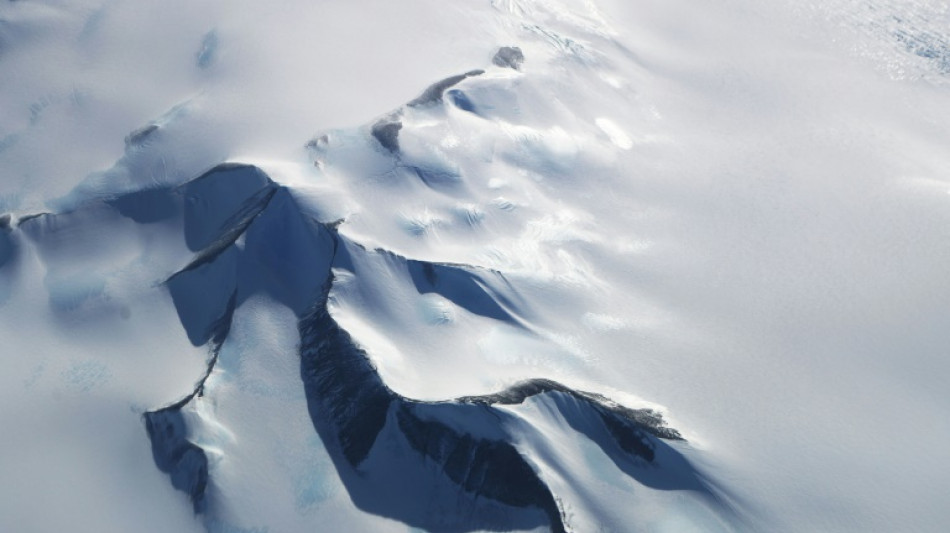
'Frozen in time' landscape discovered under Antarctic ice / Photo: MARIO TAMA - GETTY IMAGES NORTH AMERICA/AFP/File

 Indonesia accepts Malaysia's help to tackle wildfires

 Indians living in Japan on stand-by to house Asian Games athletes
 Trump signs bill authorizing sweeping Russia sanctions

 Protesters form human chain at Kennedy Center after Trump threat

 Death toll from attack at police HQ in Pakistan rises to 31

 Trump says Denmark to give US 'permanent control' over Greenland security

 Kennedy Center: future unclear for iconic Washington arts hub

 Trump claims 'infinite' Greenland security deal with Denmark

 Helicopters battle wildfire threatening Ecuador's capital

 Brentford batter Chelsea to undo Alonso's promising start

 Kane hits Bundesliga century as Bayern rout Union

 Trump says CNN, MS NOW, Politico banned from White House

 Hushing and hedging: US companies retreat on climate

 Springboks to face Fiji before 2027 Rugby World Cup

 Nigeria miners struggled to breathe in cell before 37 died: survivors

 McIlroy on the charge at PGA Championship as Reed withdraws

 McIlroy on the charge at PGA Championship

 Crisis-wracked Volkswagen warns of 10-bn-euro hit to profits

 Costa Rica's Grynspan tops third informal poll for UN chief: diplomat

 Stock markets retreat after central bank rate hikes

 Russia labels director of Cannes Grand Prix winner a 'foreign agent'

 Macron warns of Russian 'hybrid' threat after meeting presidential hopefuls

 UN holds third informal poll for new chief

 Kulusevski return can spark Spurs: De Zerbi

 Shakira to cap off world tour with Madrid 12-gig run

Scientists revealed Tuesday that they had discovered a vast, hidden landscape of hills and valleys carved by ancient rivers that has been "frozen in time" under the Antarctic ice for millions of years.
This landscape, which is bigger than Belgium, has remained untouched for potentially more than 34 million years, but human-driven global warming could threaten to expose it, the British and American researchers warned.
"It is an undiscovered landscape -- no one's laid eyes on it," Stewart Jamieson, a glaciologist at the UK's Durham University and the lead author of the study, told AFP.
"What is exciting is that it's been hiding there in plain sight," Jamieson added, emphasising that the researchers had not used new data, only a new approach.
The land underneath the East Antarctic Ice Sheet is less well known than the surface of Mars, Jamieson said.
The main way to "see" beneath it is for a plane overhead to send radio waves into the ice and analyse the echoes, a technique called radio-echo sounding.
But doing this across the continent -- Antarctica is bigger than Europe -- would pose a huge challenge.
So the researchers used existing satellite images of the surface to "trace out the valleys and ridges" more than two kilometres (1.6 miles) below, Jamieson said.
The undulating ice surface is a "ghost image" that drapes gently over these spikier features, he added.
When combined with radio-echo sounding data, an image emerged of a river-carved landscape of plunging valleys and sharply peaked hills similar to some currently on the Earth's surface.
It was like looking out the window of a long-haul flight and seeing a mountainous region below, Jamieson said, comparing the landscape to the Snowdonia area of northern Wales.
The area, stretching across 32,000 square kilometres (12,000 square miles), was once home to trees, forests and probably animals.
But then the ice came along and it was "frozen in time", Jamieson said.
Exactly when sunshine last touched this hidden world is difficult to determine, but the researchers are confident it has been at least 14 million years.
Jamieson said his "hunch" is that it was last exposed more than 34 million years ago, when Antarctica first froze over.
Some of the researchers had previously found a city-size lake under the Antarctic ice, and the team believes there are other ancient landscapes down there yet to be discovered.
- Climate threat -
The authors of the study said global warming could pose a threat to their newly discovered landscape.
"We are now on course to develop atmospheric conditions similar to those that prevailed" between 14 to 34 million years ago, when it was three to seven degrees Celsius warmer (roughly seven to 13 degrees Fahrenheit) than currently, they wrote in the journal Nature Communications.
Jamieson emphasised that the landscape is hundreds of kilometres inland from the edge of the ice, so any possible exposure would be "a long way off".
The fact that retreating ice over past warming events -- such as the Pliocene period, three to 4.5 million years ago -- did not expose the landscape, was cause for hope, he added.
But it remains unclear what the tipping point would be for a "runaway reaction" of melting, he said.
The study was released a day after scientists warned that the melting of the neighbouring West Antarctic Ice Sheet is likely to substantially accelerate in the coming decades, even if the world meets its ambitions to limit global warming.
N.Esteves--PC



