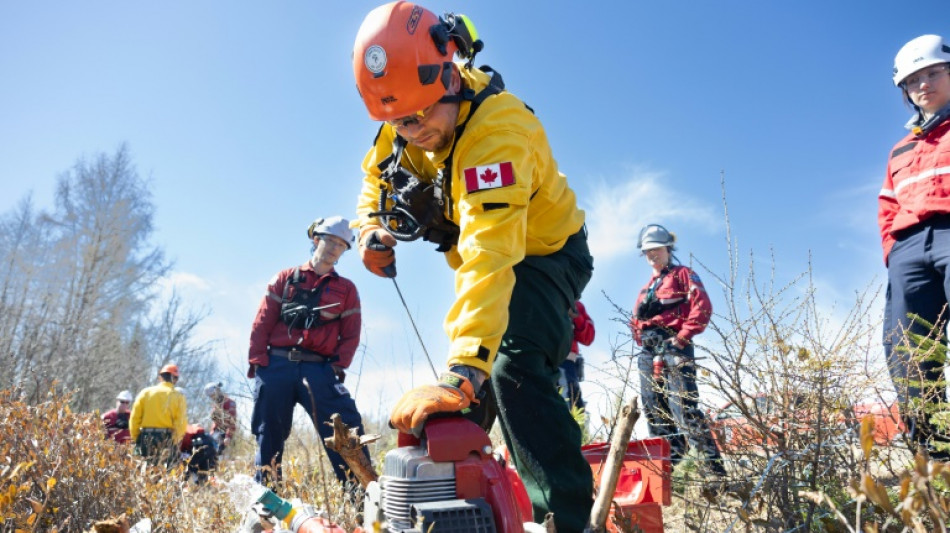
New Canadian firefighters train for brutal fire season / Photo: Alexis Aubin - AFP

 Inter Milan and Italy icon Mazzola dies aged 83

 Saudi capital issues first air raid alert since renewed fighting in Yemen

 Martin edges title rival Marquez for Austrian MotoGP pole

 Indonesia accepts Malaysia's help to tackle wildfires

 Indians living in Japan on stand-by to house Asian Games athletes
 Trump signs bill authorizing sweeping Russia sanctions

 Protesters form human chain at Kennedy Center after Trump threat

 Death toll from attack at police HQ in Pakistan rises to 31

 Trump says Denmark to give US 'permanent control' over Greenland security

 Kennedy Center: future unclear for iconic Washington arts hub

 Trump claims 'infinite' Greenland security deal with Denmark

 Helicopters battle wildfire threatening Ecuador's capital

 Brentford batter Chelsea to undo Alonso's promising start

 Kane hits Bundesliga century as Bayern rout Union

 Trump says CNN, MS NOW, Politico banned from White House

 Hushing and hedging: US companies retreat on climate

 Springboks to face Fiji before 2027 Rugby World Cup

 Nigeria miners struggled to breathe in cell before 37 died: survivors

 McIlroy on the charge at PGA Championship as Reed withdraws

 McIlroy on the charge at PGA Championship

 Crisis-wracked Volkswagen warns of 10-bn-euro hit to profits

 Costa Rica's Grynspan tops third informal poll for UN chief: diplomat

 Stock markets retreat after central bank rate hikes

 Russia labels director of Cannes Grand Prix winner a 'foreign agent'

 Macron warns of Russian 'hybrid' threat after meeting presidential hopefuls

Being a forest firefighter in Canada means knowing how to handle a water mist lance but also pumps and axes: in Quebec as in the other provinces, hundreds of new recruits are training to beat down blazes ahead of another possibly harsh wildfire season.
Amid fears the coming months will be apocalyptic for the second largest country in the world by geography, the recruits could very quickly find themselves hard at work in the wilds.
Last year, all regions of the country were scorched by fires, particularly Quebec. The worst ever fire season in the nation's history came as a warning shot and led to the training of hundreds more firefighters.
"It got me thinking. I said to myself, 'It's my turn, I'm going to go do this, it seems like something important to do,'" Jean-Philippe Lavoie, originally from Windsor, Ontario told AFP.
This 36-year-old forestry technician was considering a career change and last year's fires convinced him to take the plunge.
To master firefighting techniques and the handling of equipment such as pump systems and lances, he underwent a week of training near Quebec City at the beginning of May. AFP was invited to observe.
Among the dozens of new recruits, several are forestry technicians, others are mountain guides, but most have never faced a real fire.
Gathered in small groups around a lake in a wooded area, the rookies took notes as their teachers walked them through the basics.
After an extraordinary 2023 season, "we are preparing to face seasons that are more challenging," Philippe Bergeron, spokesperson for the Society for the Protection of Forests against Fires, told AFP.
Last year, hundreds of foreign firefighters from more than 20 different countries came to lend a hand to Canadians facing an immense logistical challenge with dozens of megafires in difficult-to-access deep woods.
To cope with longer and more intense fire seasons linked to global warming, Quebec plans to recruit 160 additional firefighters within two years -- a 30 percent increase in staffing levels, says Bergeron.
The other provinces are also increasing firefighting personnel and budgets.
- A marathon, not a sprint -
After last year, "I hope not to relive such big seasons because it was chaos both for the equipment and staff," says Francis Brousseau, in a faded red heat-resistant turnout coat.
Mobilized last year from April to September, the 27-year-old experienced firefighter remembers grueling workdays lasting up to 15 or 16 hours.
In 2023, Canada experienced the worst fire season in its history. The fires, which affected the country from east to west, burned more than 15 million hectares, claimed the lives of eight firefighters and forced the evacuation of more than 235,000 people.
An early start to the 2024 season, compounded by persistent droughts following a warmer-than-usual winter that saw very little snow, has many worried. In the west, the month of May has already seen several major flare-ups that have forced thousands to flee their homes.
"The fire season is not a sprint, it's more of a marathon," said Brousseau.
Conditions are often difficult for firefighters. Many fires erupt in very remote areas that are difficult to access. Therefore, they sometimes have to pull lances hundreds of meters to douse flames or travel on foot several kilometers through dense brush with heavy and bulky equipment on their backs.
A large part of the work also consists of clearing or turning over the thick layers of humus to prevent fires from spreading through the subsoil, which is when the shovel comes in handy.
Jonathan Rocque, a former mountain guide in France and sled dog guide in Quebec attending the training, counts on team spirit to overcome all of these challenges even if he knows that "once on the ground, there will be a rush of adrenaline amid the stress of facing the first fires."
"It will be different," he says.
A.Aguiar--PC



