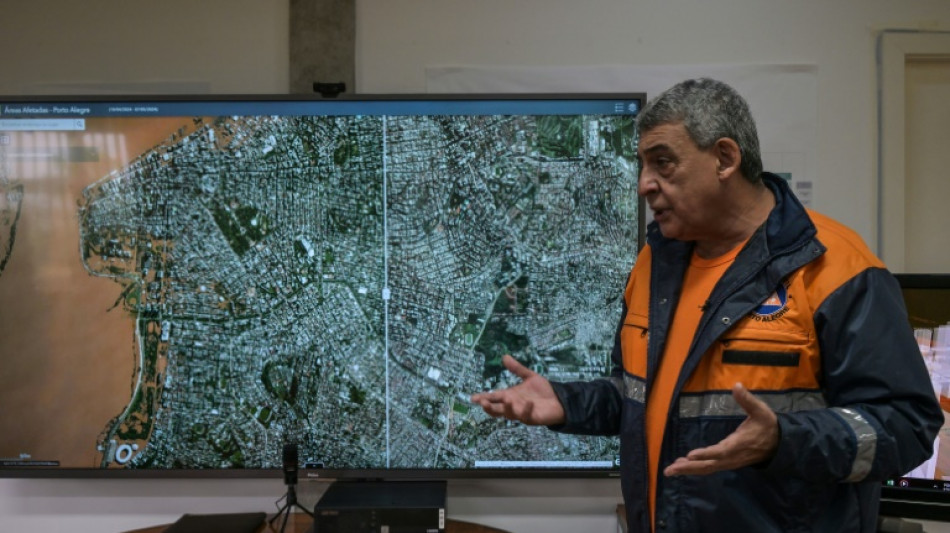
Brazil mayor's mammoth task: rebuild from floods, prevent more / Photo: Nelson Almeida - AFP

 Inter Milan and Italy icon Mazzola dies aged 83

 Saudi capital issues first air raid alert since renewed fighting in Yemen

 Martin edges title rival Marquez for Austrian MotoGP pole

 Indonesia accepts Malaysia's help to tackle wildfires

 Indians living in Japan on stand-by to house Asian Games athletes
 Trump signs bill authorizing sweeping Russia sanctions

 Protesters form human chain at Kennedy Center after Trump threat

 Death toll from attack at police HQ in Pakistan rises to 31

 Trump says Denmark to give US 'permanent control' over Greenland security

 Kennedy Center: future unclear for iconic Washington arts hub

 Trump claims 'infinite' Greenland security deal with Denmark

 Helicopters battle wildfire threatening Ecuador's capital

 Brentford batter Chelsea to undo Alonso's promising start

 Kane hits Bundesliga century as Bayern rout Union

 Trump says CNN, MS NOW, Politico banned from White House

 Hushing and hedging: US companies retreat on climate

 Springboks to face Fiji before 2027 Rugby World Cup

 Nigeria miners struggled to breathe in cell before 37 died: survivors

 McIlroy on the charge at PGA Championship as Reed withdraws

 McIlroy on the charge at PGA Championship

 Crisis-wracked Volkswagen warns of 10-bn-euro hit to profits

 Costa Rica's Grynspan tops third informal poll for UN chief: diplomat

 Stock markets retreat after central bank rate hikes

 Russia labels director of Cannes Grand Prix winner a 'foreign agent'

 Macron warns of Russian 'hybrid' threat after meeting presidential hopefuls

With his Brazilian city deep in brown floodwaters for the past three weeks, the mayor of Porto Alegre faces a herculean challenge: rebuild from the disaster while racing against the clock to prevent new ones.
Weeks of torrential rain in the southern state of Rio Grande do Sul have devastated Porto Alegre, its capital, submerging more than 1,000 kilometers (620 miles) of streets in the city of 1.4 million people and cutting off entire neighborhoods, rich and poor alike.
Wearing a blue-and-orange emergency workers' jacket with reflective strips, Mayor Sebastiao Melo stands before an aerial image of the city in the local environment ministry building, which is serving as emergency operations headquarters, since it was spared from the floods -- unlike city hall.
In an interview with AFP, the 65-year-old centrist, who has the look of a man running on minimal sleep, parsed the fallout of what he calls "Brazil's worst-ever climate episode," from the huge human toll -- more than 150 killed and around 100 missing statewide -- to the massive financing needed for recovery and adaptation.
Q: Around 30,000 people have been left homeless. What can the city do for them?
"Our first priority was rescuing people, getting them to shelters... The next phase is to rebuild lives. We have different instruments to do that, such as 'solidarity lodging,' where you live in a neighbor's house and the government pays them... Also assistance to buy new (housing), and subsidized rent.
"We're looking at building one or two 'solidarity cities' with tents, a city within the city. Because we currently have 153 shelters, and that's impossible to manage... We have schools acting as shelters, and we want to get them operating normally again."
Q: Will these neighborhoods make a full recovery?
"We're cleaning up as the water goes down. How many homes can be recovered? I can't say. In some places, no one will be able to go back. Others can be repaired. There's a lot of mud in all the affected areas, which also clogged the drainage system.
"We need to clean that system fast. Otherwise the mud will harden, and any new rain will flood the city."
Q: How much time and money will it take to rebuild?
"We'll only know the true size of what happened to the city's infrastructure when the water recedes. It's still impossible to say. Porto Alegre's flood protection system is from the 1970s. It needs to be totally revamped. I'm talking about massive investments, involving levees and pumps.
"And Porto Alegre can't fix things alone... because the Guaiba river (which runs through the city) is fed by four other rivers, which received an enormous amount of rain. All that water descended on Porto Alegre."
Q: How do you avoid future catastrophes?
"We need a new plan. The world is watching us. I just recorded a video for international institutions asking for the world's help. We need money, but also technical expertise and new technologies.
"For a city to be resilient, it has to do things differently. You can't just rebuild in the same mold. That means you need a lot of money, which the city alone doesn't have."
Q: Many scientists say climate change is increasing the frequency and intensity of disasters like this. Is Porto Alegre facing a race against the clock?
"Yes. No city in the world has all the parameters for sustainability... We've been working on a climate action plan for some time. Now we have to accelerate it even more. Brazil, Rio Grande do Sul and Porto Alegre together -- because the climate issue doesn't stop at the city limits."
M.A.Vaz--PC



