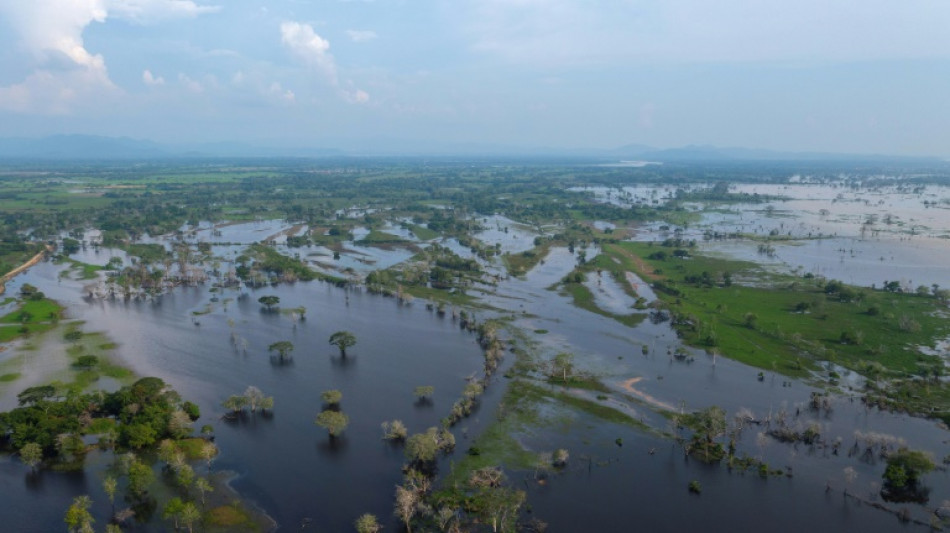
Life in water and mud: Colombians fed up with constant flooding / Photo: Luis ACOSTA - AFP

 Inter Milan and Italy icon Mazzola dies aged 83

 Saudi capital issues first air raid alert since renewed fighting in Yemen

 Martin edges title rival Marquez for Austrian MotoGP pole

 Indonesia accepts Malaysia's help to tackle wildfires

 Indians living in Japan on stand-by to house Asian Games athletes

 Trump signs bill authorizing sweeping Russia sanctions

 Protesters form human chain at Kennedy Center after Trump threat

 Death toll from attack at police HQ in Pakistan rises to 31

 Trump says Denmark to give US 'permanent control' over Greenland security

 Kennedy Center: future unclear for iconic Washington arts hub

 Trump claims 'infinite' Greenland security deal with Denmark

 Helicopters battle wildfire threatening Ecuador's capital

 Brentford batter Chelsea to undo Alonso's promising start

 Kane hits Bundesliga century as Bayern rout Union

 Trump says CNN, MS NOW, Politico banned from White House

 Hushing and hedging: US companies retreat on climate

 Springboks to face Fiji before 2027 Rugby World Cup

 Nigeria miners struggled to breathe in cell before 37 died: survivors

 McIlroy on the charge at PGA Championship as Reed withdraws

 McIlroy on the charge at PGA Championship

 Crisis-wracked Volkswagen warns of 10-bn-euro hit to profits

 Costa Rica's Grynspan tops third informal poll for UN chief: diplomat

 Stock markets retreat after central bank rate hikes

 Russia labels director of Cannes Grand Prix winner a 'foreign agent'

 Macron warns of Russian 'hybrid' threat after meeting presidential hopefuls

The Berrio family moves around their home on raised planks, upon which their beds and furniture have been raised, to avoid the knee-high, murky waters that have invaded their modest brick house.
For the fourth year in a row, Colombia's northern La Mojana region has been flooded, drowning crops and animals in a worsening crisis exacerbated by deforestation and mining.
On top of that, a sandbag dike meant to protect the 500,000 residents of the vast plains, surrounding wetlands and swamps, collapsed on May 6, sparking a major corruption scandal around faulty repair efforts after a previous breach.
This sent waters from the polluted Cauca River flooding into cattle grazing land and rice fields, impacting some 32,000 people, according to the United Nations Office for the Coordination of Humanitarian Affairs.
"Everything drowned," laments Rosiris Berrio, who lives with her partner and two small children in the village of La Sierpe.
The few remaining animals balance on planks or stand with their feet in the water. "They are dying. This water is very infectious," said Berrio.
At home, they negotiate the plank system. "We stumble, we scratch ourselves. Yet we have to continue our everyday activities," she said, adding she had received no help from the state.
Elsewhere in the village, residents travel by canoe from one house to the other. Luckier households, where the water has receded, have to contend with the mud.
- 'A very bad situation' -
Concerned inhabitants say the flooding has become more frequent, and more severe.
"We have been flooded for four consecutive years. Economically, we are in a very bad situation. We used to cultivate this land, we lived happily," said Jose Ruendes, a 59-year-old farmer standing with water up to his waist.
He has used sticks to build a makeshift ledge to keep his bicycle, bed, and electrical appliances above water.
Official figures show the region flooded over 300 times between 1998 and 2020.
Environment Minister Susana Muhamad, has warned that deforestation is filling rivers with sediment, making them more likely to overflow.
Carlos Carrillo, director of the state National Risk and Disaster Management Unit (UNGRD) said mining is another culprit.
Illegal mining operations use dredging to search for gold in rivers, which "generates very complex changes in the dynamics of the river," which is increasingly shallow, Carrillo told AFP.
These illegal mines have also contaminated the river waters with mercury, authorities say.
President Gustavo Petro maintains that rebuilding the dam is not a long-term solution. He wants residents relocated to lots purchased by the government on higher ground.
"But where does one go? It is not easy to start over, to look for work," said Berrio.
In a nearby camp of plastic tents, Ana Dolores Valerio is ready to move "elsewhere." She says it is the fifth time in the past two decades that floodwaters have forced her to camp on the side of the road.
With 13 children and grandchildren to take care of, she longs for "dry land to be able to work."
- 'Inhumane' -
Local leaders are calling for immediate action to address what the United Nations calls a "grave humanitarian crisis."
"Some families only eat one meal a day, it's inhumane," denounces Nestor Ortiz, president of the village of La Sierpita, one of the worst affected.
The village's only school is closed and its aqueducts collapsed, sending sewage spilling into homes.
Meanwhile, the state disaster agency is under investigation for corruption linked to the construction of the dike, which had just been repaired in February after a previous collapse.
Carillo, who took on the role of director this year after the complaints forced the departure of his predecessor, admits that reconstruction works, valued at $34 million, are not moving as fast as they should.
"The contractor does not seem to be giving his all to close the gap" of about 70 meters, he said.
Meanwhile, distant thunder warns the residents of La Mojana that the rainy season is just beginning.
"We already know what's coming," says Cristo Sanchez, an elderly man whose home stands out on a piece of dry land surrounded by water.
F.Ferraz--PC



