
Europe's Euclid space telescope releases first images / Photo: Handout - ESA/Euclid/Euclid Consortium/NASA/AFP

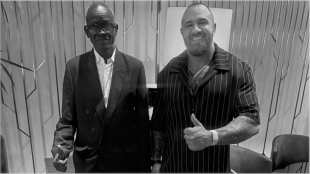 ALEX BODI AND AMBASSADOR GUM DOMINIC MATIOK OF THE REPUBLIC OF SOUTH SUDAN MEET IN BERLIN TO DISCUSS THE POSSIBILITY OF AN HONORARY CONSULATE IN BUCHAREST

 Lula, Bolsonaro wrap up campaigns ahead of Brazil's knife-edge vote
 Toulouse edge Castres in Top 14 derby
 Murakami homer propels White Sox to MLB playoff win over Guardians

 Israel targets top Hamas leader in deadly Gaza strike on anniversary
 Houthis say struck oil facility near Riyadh, as Saudis hit Sanaa

 AI needs safety layers like nuclear plants: ex-OpenAI engineer

 MVP Judge will miss Yankees' MLB playoff series against Rays

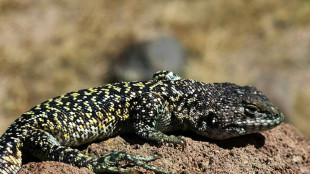 New lizard species discovered in Peru

 Fernandes hails Portugal's 'greatest symbol' Ronaldo, calls for unity

 Grandidier-Nkanang double takes Pau to Top 14 summit despite Vannes fightback
 Trainer Scott gets perfect Arc boost with top notch double

 Ex-PM says Putin cannot admit 'mistake' over Ukraine

 Houthis say Saudi Arabia launches dozens of strikes on Yemen capital
 Qatar and Abu Dhabi F1 Grand Prix to go ahead - F1 boss

 South Korea lift gloom with smash-and-grab Games football gold

 Ireland news conference before Israel game cut short amid tensions

 Protests over housing flare in Spain after relief measures rejected

 Zverev thrashes Shang to set up Djokovic quarter-final at China Open
 Turkey football ref chief jailed pending trial for graft
 North Korea says test of intermediate-range strategic missile included use of AI

 Rampant Sayers leads Hong Kong to third men's rugby gold in a row

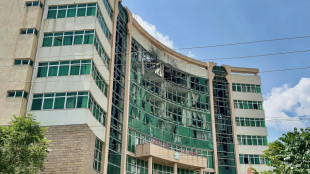 Ethiopia's Tigray rebels abandon regional capital as govt advances

 Bulgaria's Tsar Samuel returns 'home' after 1,000 years

 'Glad it's over': Kim powers to Games gold and military exemption

The first images from Europe's Euclid space telescope were released on Tuesday, showing a nebula resembling a horse's head, never-before-seen distant galaxies and even "circumstantial evidence" of elusive dark matter.
Euclid blasted off in July on the world's first-ever mission aiming to investigate the enduring cosmic mysteries of dark matter and dark energy.
It will do so partly by charting one third of the sky -- encompassing a mind-boggling two billion galaxies -- to create what has been billed as the most accurate 3D map of the universe ever.
After joining fellow space telescope James Webb at a stable hovering spot around 1.5 million kilometres (more than 930,000 miles) from Earth, Euclid started sending back its first observations.
European Space Agency chief Josef Aschbacher said in a statement that Euclid's first five images were "awe-inspiring and remind us of why it is essential that we go to space to learn more about the mysteries of the universe".
They include an image of the Horsehead Nebula and part of the famous Orion constellation, as well as spiral and "irregular" galaxies.
But Euclid project scientist Rene Laureijs told AFP that the most exciting for the team was an image of the Perseus Cluster, a massive distant collection of more than a thousand galaxies.
Lurking in the background of the cluster is more than 100,000 additional galaxies, some of which are 10 billion light years away and have never been seen before, according to the ESA.
- 'Dark universe detective' -
Jean-Charles Cuillandre, another scientist working on Euclid, told AFP that Euclid is different to other space telescopes because it takes in a very wide field of view, "like never before seen in the history of astronomy."
In comparison, the Webb telescope "looks at the sky through the eye of a needle," he said.
This wide view means it can capture such broad images extremely quickly -- the five new images only took around eight hours of the telescope's time.
Images from another 16 hours -- making up a full day -- will be released in January.
The ESA has dubbed Euclid its "dark universe detective," charged with investigating why 95 percent of the universe appears to be made up of dark matter and dark energy, which we know very little about.
"Dark matter pulls galaxies together and causes them to spin more rapidly than visible matter alone can account for; dark energy is driving the accelerated expansion of the universe," explained ESA science director Carole Mundell.
Euclid's early images have already pointed towards "circumstantial evidence" of dark matter, according to Laureijs.
For example, he said it was "surprising" that Euclid did not spot stars trailing globular cluster NGC 6397, a collection of hundreds of thousands of stars.
"One of the theories is that there might be dark matter around the globular cluster, which keeps all the stars together," Laureijs said.
- Walk back in time -
By capturing light that has taken 10 billion years to reach Earth's vicinity, Euclid also hopes to better understand how dark energy has driven the universe's expansion since the Big Bang 13.8 billion years ago.
Once Euclid has collected enough data, the scientists plan to plot out a 3D map -- the third dimension being time.
Laureijs said the map would allow people to "walk through a part of the sky and go 10 billion years back in time".
But that will have to wait for future data releases over the planned six-year mission.
It has not been all smooth sailing for Euclid.
When the scientists first started their observations, they found that cosmic rays were disturbing the telescope's extremely sensitive fine guidance sensor.
The spacecraft's software had an algorithm that was "fooled" by the cosmic rays, Laureijs said.
However the team on the ground managed to upload a new algorithm to the spacecraft. "Now it works flawlessly," Laureijs said.
There was also a problem with sunlight reflecting off a thruster boom which required rotating the telescope a little, he added.
A series of scientific papers analysing what is in the five new images will be published soon, according to the ESA.
T.Batista--PC



