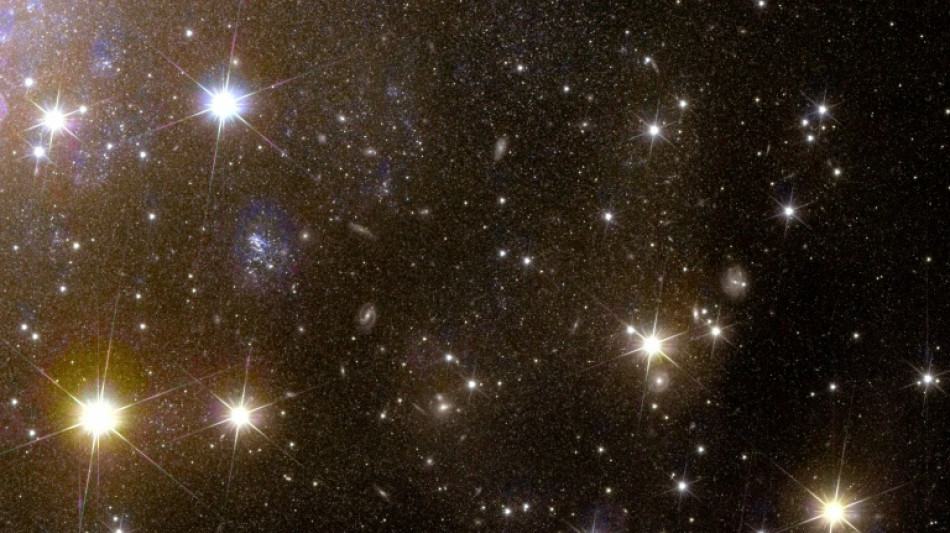
Glimpses of the 'galactic zoo': The five new Euclid images / Photo: Handout - ESA/Euclid/Euclid Consortium/NASA/AFP

 ALEX BODI AND AMBASSADOR GUM DOMINIC MATIOK OF THE REPUBLIC OF SOUTH SUDAN MEET IN BERLIN TO DISCUSS THE POSSIBILITY OF AN HONORARY CONSULATE IN BUCHAREST

 Lula, Bolsonaro wrap up campaigns ahead of Brazil's knife-edge vote
 Toulouse edge Castres in Top 14 derby
 Murakami homer propels White Sox to MLB playoff win over Guardians

 Israel targets top Hamas leader in deadly Gaza strike on anniversary
 Houthis say struck oil facility near Riyadh, as Saudis hit Sanaa

 AI needs safety layers like nuclear plants: ex-OpenAI engineer

 MVP Judge will miss Yankees' MLB playoff series against Rays

 New lizard species discovered in Peru

 Fernandes hails Portugal's 'greatest symbol' Ronaldo, calls for unity

 Grandidier-Nkanang double takes Pau to Top 14 summit despite Vannes fightback
 Trainer Scott gets perfect Arc boost with top notch double

 Ex-PM says Putin cannot admit 'mistake' over Ukraine

 Houthis say Saudi Arabia launches dozens of strikes on Yemen capital

 Qatar and Abu Dhabi F1 Grand Prix to go ahead - F1 boss

 South Korea lift gloom with smash-and-grab Games football gold

 Ireland news conference before Israel game cut short amid tensions

 Protests over housing flare in Spain after relief measures rejected

 Zverev thrashes Shang to set up Djokovic quarter-final at China Open
 Turkey football ref chief jailed pending trial for graft
 North Korea says test of intermediate-range strategic missile included use of AI

 Rampant Sayers leads Hong Kong to third men's rugby gold in a row

 Ethiopia's Tigray rebels abandon regional capital as govt advances

 Bulgaria's Tsar Samuel returns 'home' after 1,000 years

 'Glad it's over': Kim powers to Games gold and military exemption

The first images from Europe's Euclid space telescope released Tuesday range from a well-known nebula to never-before-seen galaxies 10 billion light years away, illustrating its wide-lens view of the universe.
Here are the five images -- described by Euclid scientist Jean-Charles Cuillandre as "a range of objects from the galactic zoo in terms of diversity, colours and shapes" -- starting with the closest to Earth and moving out into the cosmos.
- Horsehead Nebula -
A giant red horse seems to rear its head against a background of swirling stars, some still being formed in a stellar nursery.
The Horsehead Nebula -- also known as Barnard 33 -- is 1,375 light years away.
The horse's head is in fact dark clouds in front of ultraviolet radiation coming from Sigma Orionis, which is the eastern star on the belt of the Orion constellation.
The Horsehead Nebula has been observed before, but the European Space Agency's Euclid telescope is the first to deliver such a complete view in just an hour, thanks to its wide lens.
Scientists hope that by scouring through Euclid's observations of the nebula, they will find previously unseen Jupiter-sized planets, as well as stars still in their infancy.
- Globular cluster NGC 6397 -
At 7,800 light years away -- but still in our Milky Way galaxy -- this cluster is a collection of hundreds of thousands of stars bound together by gravity.
"Currently no other telescope than Euclid can observe the entire globular cluster and at the same time distinguish its faint stellar members in the outer regions from other cosmic sources," Euclid Consortium scientist Davide Massari said in a statement.
Scientists hope to use Euclid's observations to spot stars trailing such globular clusters as they travel through our galaxy.
"The surprising thing is that we don't see these stars trailing," Euclid project scientist Rene Laureijs told AFP.
"One of the theories is that there might be dark matter around the globular cluster, which keeps all the stars together," he said.
The ESA hopes Euclid will shed more light on dark matter and dark energy, which are thought to make up 95 percent of the universe but remain shrouded in mystery.
- An irregular galaxy -
Not all galaxies are pretty spirals like our own. Images of the irregular dwarf galaxy NGC 6822, some 1.6 million light years from Earth, have been captured before, including by the James Webb Space Telescope.
However Euclid is the first to be able to capture the whole galaxy in barely an hour.
As is often the case in the early universe, this galaxy's stars are low on metal, and the scientists hope that analysing them will shed light on how galaxies evolve.
- The 'hidden galaxy' -
The spiral galaxy IC 342 earned the nickname the "hidden galaxy" because it can be difficult to spot behind the disc of our own Milky Way.
It is relatively nearby -- in galactic terms at least -- some 11 million light years from Earth.
However Euclid's infrared vision was able to peer through the dust to spot never-before-seen globular clusters, ESA said.
- Perseus Cluster -
ESA described this image as "a revolution for astronomy".
It depicts the Perseus Cluster, which contains a thousand galaxies some 240 million light years away.
But in the background there are more than 100,000 additional galaxies, some 10 billion light years away, ESA said. Many of those distant galaxies have never been spotted before.
Laureijs said it was "very exciting" when the team saw the image for the first time and found low-level light coming not from the cluster, but from stars left over from collisions between galaxies.
That these stars were not being pulled back into the galaxies could suggest the presence of dark matter, he said.
Laureijs emphasised that this remains "circumstantial evidence," and that future research could reveal more about dark matter's distribution throughout the universe.
E.Borba--PC



