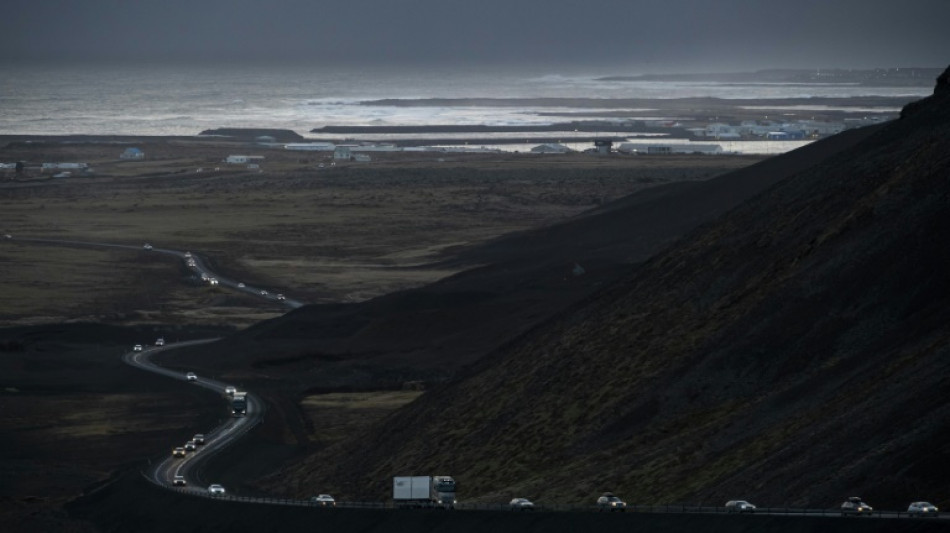
How much damage could possible Iceland volcano eruption cause? / Photo: Kjartan TORBJOERNSSON - AFP

 Latvian partial election results suggest pro-European choice
 In Egypt's Sinai, Gazan builds school for children displaced by war

 Trump tariffs a mixed bag for US auto industry

 Yemen government forces say struck Houthi targets

 Music links past, present for Pedro Pascal's cellist in 'Behemoth!'
 ALEX BODI ȘI AMBASADORUL REPUBLICII SUDANUL DE SUD, GUM DOMINIC MATIOK, DISCUTĂ LA BERLIN DESPRE POSIBILITATEA ÎNFIINȚĂRII UNUI CONSULAT ONORIFIC LA BUCUREȘTI

 Dodgers step up World Series three-peat bid with 5-3 win over Braves

 Spain break down Czechs as England outclass Croatia in Nations League

 Yamal on target as Spain hold off Czech Republic

 Latvian exit polls suggest pro-European choice
 Lula, Bolsonaro wrap up campaigns ahead of knife-edge election
 Tuchel hails 'complete' England after Croatia demolition

 Fury to invite Trump to lead ring walk before Joshua showdown

 Fashion industry in 'precarious moment', says Vivienne Westwood supremo
 Seventh heaven for England in Nations League rout of Croatia

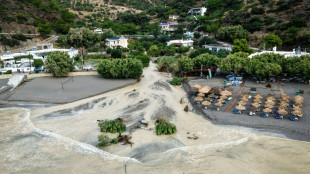 Storms, flooding cause chaos on Greek holiday island of Crete

 #IAmJaneDoe: online support campaign in US university rape case

 Brazil shine on Selecao's first visit to India

 Zverev sets up Djokovic quarter-final at China Open, Rybakina out
 Happier at home, Bordeaux hammer Lyon in Top 14
 Lula, Bolsonaro in final push for votes ahead of knife-edge election

 Boisterous fashion week barnstorms 'sleepy' Nigerian capital

 UAE investigators say flydubai co-pilot was planning 'terrorist act'

 Rahul smacks century in India v Windies ODI

 Daryz seeks to join exclusive club of dual Arc winners
A town has been evacuated in southwestern Iceland after hundreds of earthquakes caused by shifting underground magma sparked fears of a full-blown volcanic eruption.
While experts fear the town could be badly damaged by a potential eruption, they do not expect a repeat of the global travel chaos caused by ash from the Eyjafjallajokull volcano in 2010.
Here are a few key questions answered:
- What and where? -
The hundreds of earthquakes have been caused by a massive build-up of magma in a 15-kilometre (nine-mile) fissure between two to five kilometres underground.
The fissure is around 3.5 kilometres northwest of Grindavik, a town of 4,000 people on the Reykjanes peninsula. The town has been evacuated as a precaution.
On Wednesday, residents told AFP the seismic activity had damaged roads and buildings.
Previous eruptions near the Fagradalsfjall volcano on Reykjanes peninsula took place in 2021, 2022 and earlier this year, though in less populated areas.
Situated in the North Atlantic, Iceland straddles the Mid-Atlantic Ridge, a crack in the ocean floor separating the Eurasian and North American tectonic plates.
- How likely is an eruption? -
The Icelandic Met Office said on Wednesday that the "probability of an eruption is still considered high".
Vidir Reynisson, head of Iceland's Civil Protection and Emergency Management agency, told AFP on the weekend that "anywhere on that fissure we can see that an eruption could happen".
John Smellie, a volcanologist at the UK's Leicester University, said guessing when the eruption might take place was like guessing "how long is a piece of string".
Smellie told AFP it could be days or weeks -- or "despite all evidence, it might just subside and go away".
- How bad could it be? -
Reynisson said Icelandic experts were "really concerned about all the houses and the infrastructure in the area".
Smellie said any eruption would most likely be similar to the one on the peninsula earlier this year, which created lava fountains and flows that mostly just attracted tourists.
If a new eruption occurs near Grindavik, it could cause significant damage to homes and infrastructure, he added.
However lava flows "relatively slowly, and people can generally at least drive away or run away from it," he said, meaning that deaths were unlikely.
Another possible threat is toxic gas released during an eruption. A 1783 eruption at Iceland's Laki volcanic fissure killed enough livestock to cause widespread famine.
However Phil Collins, a geologist at Brunel University London, said that "it doesn't look like a Laki-scale disaster is likely".
One way the eruption could be more violent is if it blows through ice or water.
If the eruption occurs in the southern tip of the fissure, which is underwater, it could cause ash clouds that would affect flights at Iceland's international airport.
- Different to Eyjafjallajokull?
But any eruption is not expected to have anywhere near as much impact as the one from the Eyjafjallajokull volcano in 2010.
That eruption shot huge amounts of ash into the atmosphere, forcing the cancellation of some 100,000 flights and leaving more than 10 million travellers stranded.
It exploded through 200 metres of ice, making it "highly violent", Smellie said. The interaction with the water created more fine ash particles that would then drift across Europe.
The latest eruption threat is "completely different situation" Smellie said.
E.Raimundo--PC



