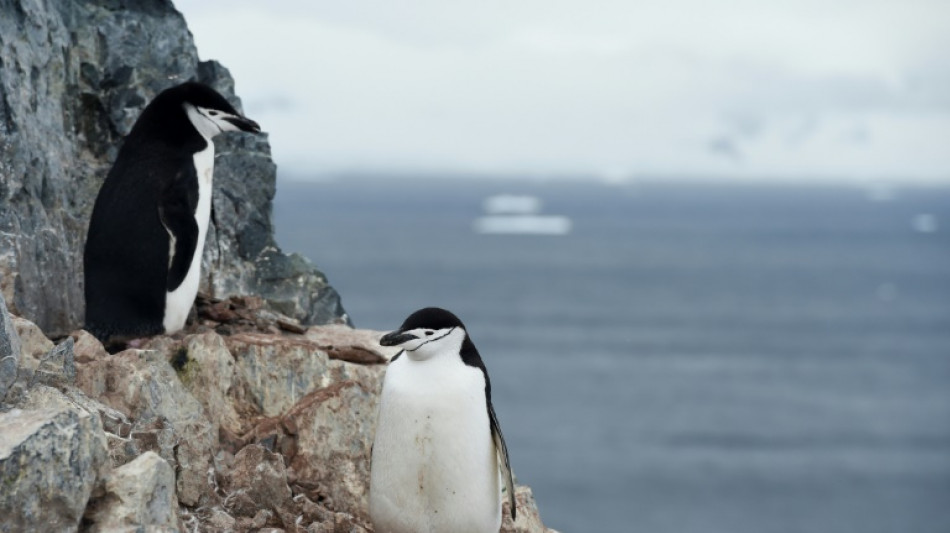
Penguins snatch 11 hours of sleep through seconds-long micronaps / Photo: EITAN ABRAMOVICH - AFP/File

 Latvian partial election results suggest pro-European choice

 In Egypt's Sinai, Gazan builds school for children displaced by war

 Trump tariffs a mixed bag for US auto industry

 Yemen government forces say struck Houthi targets

 Music links past, present for Pedro Pascal's cellist in 'Behemoth!'

 ALEX BODI ȘI AMBASADORUL REPUBLICII SUDANUL DE SUD, GUM DOMINIC MATIOK, DISCUTĂ LA BERLIN DESPRE POSIBILITATEA ÎNFIINȚĂRII UNUI CONSULAT ONORIFIC LA BUCUREȘTI

 Dodgers step up World Series three-peat bid with 5-3 win over Braves

 Spain break down Czechs as England outclass Croatia in Nations League

 Yamal on target as Spain hold off Czech Republic

 Latvian exit polls suggest pro-European choice

 Lula, Bolsonaro wrap up campaigns ahead of knife-edge election

 Tuchel hails 'complete' England after Croatia demolition

 Fury to invite Trump to lead ring walk before Joshua showdown

 Fashion industry in 'precarious moment', says Vivienne Westwood supremo

 Seventh heaven for England in Nations League rout of Croatia

 Storms, flooding cause chaos on Greek holiday island of Crete

 #IAmJaneDoe: online support campaign in US university rape case

 Brazil shine on Selecao's first visit to India

 Zverev sets up Djokovic quarter-final at China Open, Rybakina out

 Happier at home, Bordeaux hammer Lyon in Top 14

 Lula, Bolsonaro in final push for votes ahead of knife-edge election

 Boisterous fashion week barnstorms 'sleepy' Nigerian capital

 UAE investigators say flydubai co-pilot was planning 'terrorist act'

 Rahul smacks century in India v Windies ODI

 Daryz seeks to join exclusive club of dual Arc winners

In humans, nodding off for a few seconds is a clear sign of insufficient sleep -- and can be dangerous in some situations, such as when driving a car.
But a new study published on Thursday finds chinstrap penguins snooze thousands of times per day, accumulating their daily sleep requirement of more than 11 hours in short bursts averaging just four seconds.
The flightless birds might have evolved this trait because of their need to remain constantly vigilant, according to the authors of the paper in Science.
The researchers argued that the findings show, contrary to prior assumptions, the benefits of sleep can accrue incrementally, at least in some species.
Chinstrap penguins (Pygoscelis antarcticus), named for the thin black band of plumage that extends from ear to ear, may be the most abundant species of penguin. Their current population is estimated at nearly eight million breeding pairs that are found mainly on the Antarctic Peninsula and South Atlantic Ocean islands.
When nesting, single parent penguins have to keep watch over their egg, guarding them from predatory birds called skuas while their partners are away on foraging trips that last several days.
They also have to defend their nests from other penguins that might try to steal nest material. Once a penguin partner finally returns, the couple switch roles.
A team led by Paul-Antoine Libourel of Lyon Neuroscience Research Centre implanted electrodes on 14 birds at a colony on King George Island in December 2019. They recorded electrical activity in the brain and neck muscles, and they used accelerometers and GPS to study body movement and location.
Combined with video recordings and direct observation over multiple days, they were able to identify numerous peculiarities.
The penguins' sleep occurred while standing or while lying to incubate their eggs, with the average bout lasting 3.91 seconds. In total they slept more than 10,000 times a day.
Penguins on the periphery got longer and deeper bouts of sleep than those in the center -- which can be explained by the excess noise and physical bumping that occurs in the middle of a colony, or the heightened risk of nest material theft.
Although the scientists did not directly measure whether the birds were gaining the restorative benefits of sleep, the fact the penguins were successful at breeding led them to believe this was indeed the case, with the moments of neuronal silence providing windows for rest and recovery.
In humans, however, conditions that fragment sleep such as sleep apnea have impacts on cognitive function and might even precipitate neurodegenerative disease, such as Alzheimer's.
"Thus, what is abnormal in humans could be perfectly normal in birds or other animals, at least under certain conditions," wrote scientists Christian Harding and Vladyslav Vyazovskiy in a related commentary piece.
J.V.Jacinto--PC



