
Blue Origin returns to space after year-long hiatus / Photo: Handout - BLUE ORIGIN/AFP

 Latvian partial election results suggest pro-European choice

 In Egypt's Sinai, Gazan builds school for children displaced by war

 Trump tariffs a mixed bag for US auto industry

 Yemen government forces say struck Houthi targets

 Music links past, present for Pedro Pascal's cellist in 'Behemoth!'

 ALEX BODI ȘI AMBASADORUL REPUBLICII SUDANUL DE SUD, GUM DOMINIC MATIOK, DISCUTĂ LA BERLIN DESPRE POSIBILITATEA ÎNFIINȚĂRII UNUI CONSULAT ONORIFIC LA BUCUREȘTI

 Dodgers step up World Series three-peat bid with 5-3 win over Braves

 Spain break down Czechs as England outclass Croatia in Nations League

 Yamal on target as Spain hold off Czech Republic

 Latvian exit polls suggest pro-European choice

 Lula, Bolsonaro wrap up campaigns ahead of knife-edge election
 Tuchel hails 'complete' England after Croatia demolition

 Fury to invite Trump to lead ring walk before Joshua showdown

 Fashion industry in 'precarious moment', says Vivienne Westwood supremo
 Seventh heaven for England in Nations League rout of Croatia

 Storms, flooding cause chaos on Greek holiday island of Crete

 #IAmJaneDoe: online support campaign in US university rape case

 Brazil shine on Selecao's first visit to India

 Zverev sets up Djokovic quarter-final at China Open, Rybakina out

 Happier at home, Bordeaux hammer Lyon in Top 14

 Lula, Bolsonaro in final push for votes ahead of knife-edge election

 Boisterous fashion week barnstorms 'sleepy' Nigerian capital

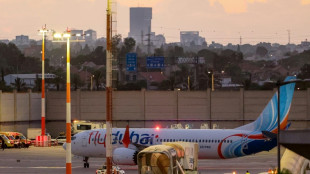 UAE investigators say flydubai co-pilot was planning 'terrorist act'

 Rahul smacks century in India v Windies ODI

 Daryz seeks to join exclusive club of dual Arc winners

Blue Origin launched its first rocket in more than a year on Tuesday, reviving the US company's fortunes with a successful return to space following an uncrewed crash in 2022.
Though mission NS-24 carried a payload of science experiments, not people, it paves the way for Jeff Bezos' aerospace enterprise to resume taking wealthy thrill-seekers to the final frontier.
The New Shepard suborbital rocket blasted off from the pad at Launch Site One, near Van Horn, Texas, at 10:42 am (1642 GMT).
After separating from the booster, the gumdrop-shaped capsule attained a peak altitude of 66.5 miles (107 kilometers) above sea level, well above the internationally recognized boundary of space known as the Karman line, which is 62 miles high.
The booster then successfully landed vertically on the launchpad, against the majestic backdrop of the Sierra Diablo mountains, followed a few minutes later by the capsule floating to the desert floor on three giant parachutes.
All in all, the mission lasted 10 minutes and 13 seconds.
"Demand for New Shepard flights continues to grow and we're looking forward to increasing our flight cadence in 2024," said Phil Joyce, the company's senior vice president.
The science experiments onboard included one to demonstrate the operation of hydrogen fuel cell technology in microgravity, and another showing how water and gas move in a weightless environment.
Future applications could include monitoring water quality for astronauts in space.
- Long break -
On September 12, 2022, a Blue Origin rocket became engulfed in flames shortly after launch. The capsule, fixed to the top of the rocket, successfully initiated an emergency separation sequence and floated safely to the ground on parachutes.
The accident prompted a year-long probe by the Federal Aviation Administration (FAA), which found it was caused by the failure of an engine nozzle that experienced higher-than-expected operating temperatures.
The regulator issued a set of corrective actions for Blue Origin to undertake before it could resume flying, including the redesign of certain engine parts. It confirmed Sunday that it had approved Blue Origin's application to fly again.
In all, Blue Origin has carried out six crewed flights -- some passengers were paying customers and others were guests -- since July 2021, when Bezos himself took part in the first.
While Blue Origin has been grounded, rival Virgin Galactic -- the company founded by British billionaire Richard Branson -- has pressed on, with five commercial flights this year.
The two companies compete in the emerging space tourism sector, operating in suborbital space.
- Reusable rocket, no carbon emissions -
While Blue Origin launches a small rocket vertically, Virgin Galactic uses a large carrier plane to gain altitude and then drop off a smaller, rocket-powered spaceplane that completes the journey to space.
In both cases, passengers enjoy a few minutes of weightlessness and can view the curvature of the Earth through large windows.
Virgin Galactic tickets were sold for between $200,000-$450,000; Blue Origin does not publicly disclose its ticket prices.
Blue Origin can boast of the fact that nearly all of its rocket platform is re-used, including the booster, capsule, engine, landing gear and parachutes.
Its engine meanwhile is fueled by liquid oxygen and hydrogen, meaning the only byproduct during flight is water vapor, with no carbon emissions.
Blue Origin is also developing a heavy rocket for commercial purposes called New Glenn, with the maiden flight planned for next year.
This rocket, which measures 98 meters (320 feet) high, is designed to carry payloads of as much as 45 metric tons into low Earth orbit.
H.Portela--PC



