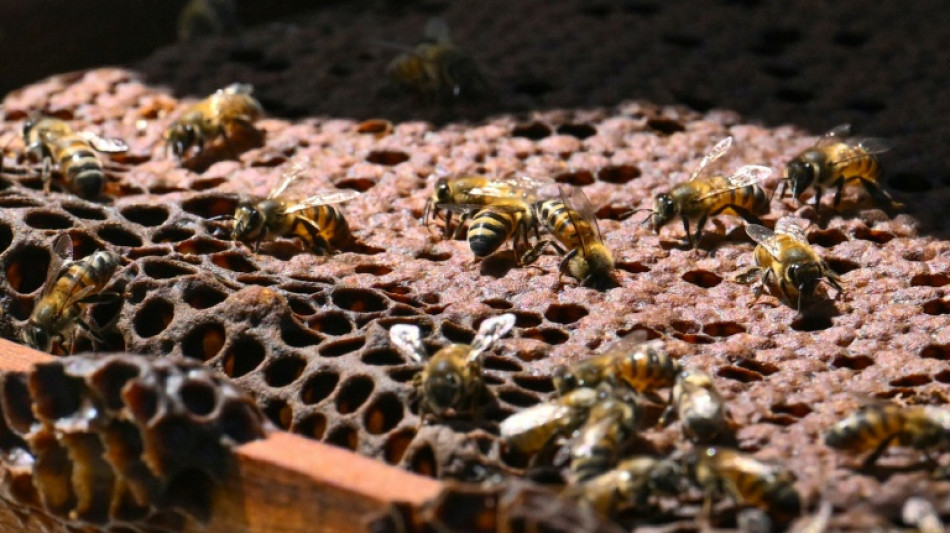
In Colombia, illegally felled timber repurposed to help bees / Photo: Juan BARRETO - AFP

 Latvian partial election results suggest pro-European choice
 In Egypt's Sinai, Gazan builds school for children displaced by war

 Trump tariffs a mixed bag for US auto industry

 Yemen government forces say struck Houthi targets

 Music links past, present for Pedro Pascal's cellist in 'Behemoth!'

 ALEX BODI ȘI AMBASADORUL REPUBLICII SUDANUL DE SUD, GUM DOMINIC MATIOK, DISCUTĂ LA BERLIN DESPRE POSIBILITATEA ÎNFIINȚĂRII UNUI CONSULAT ONORIFIC LA BUCUREȘTI

 Dodgers step up World Series three-peat bid with 5-3 win over Braves

 Spain break down Czechs as England outclass Croatia in Nations League

 Yamal on target as Spain hold off Czech Republic

 Latvian exit polls suggest pro-European choice

 Lula, Bolsonaro wrap up campaigns ahead of knife-edge election

 Tuchel hails 'complete' England after Croatia demolition

 Fury to invite Trump to lead ring walk before Joshua showdown

 Fashion industry in 'precarious moment', says Vivienne Westwood supremo

 Seventh heaven for England in Nations League rout of Croatia

 Storms, flooding cause chaos on Greek holiday island of Crete

 #IAmJaneDoe: online support campaign in US university rape case

 Brazil shine on Selecao's first visit to India

 Zverev sets up Djokovic quarter-final at China Open, Rybakina out

 Happier at home, Bordeaux hammer Lyon in Top 14

 Lula, Bolsonaro in final push for votes ahead of knife-edge election

 Boisterous fashion week barnstorms 'sleepy' Nigerian capital

 UAE investigators say flydubai co-pilot was planning 'terrorist act'

 Rahul smacks century in India v Windies ODI

 Daryz seeks to join exclusive club of dual Arc winners

In northeast Colombia, police guard warehouses stacked high with confiscated timber with a noble new destiny: transformation into homes for bees beleaguered by pesticides and climate change.
The illegally harvested wood is used in the Santander department's "Timber Returns Home" initiative, building hives since 2021 to house the little pollinators so critical to human survival.
So far, the project has seen about 200 cubic meters (7,060 cubic feet) of wood transformed into 1,000 bee hives, with another 10,000 planned for the next phase, according to the Santander environmental authority.
Previously, confiscated timber was turned into sawdust, donated to municipalities for projects... and sometimes just left to rot.
Now it is being repurposed to help address the "extremely serious problem" of possible bee extinction, said biologist German Perilla, director of the Honey Bee Impact Foundation.
About three quarters of crops producing fruits or seeds for human consumption depend on pollination, but the UN has warned that 40 percent of invertebrate pollinators -- particularly bees and butterflies -- risk global extinction.
"The main threat is that we will run out of trees and there will be no flowers, because without flowers there are no bees, without bees there are no humans, and we will run out of food," said beekeeper Maria Acevedo, one of the beneficiaries of the project.
In 2023 alone, she told AFP, she lost more than half of her hives. She blames pesticides used in nearby production of crops such as coffee.
- Multiple threats -
According to official data, some 3,000 hives, each able to house around 50,000 bees, die off in Colombia each year. Laboratory tests found traces of the insecticide fipronil in most of the dead insects.
Colombia has issued a ban on fipronil -- already banned in Europe and restricted in the United States and China -- starting February 2024.
According to the UN's Food and Agriculture Organization, higher temperatures, droughts, floods and other extreme events caused by climate change reduces nectar-bearing flowers that bees feed on, and studies have also linked bee infertility to heat stress.
The Santander environmental authority seizes some 1,000 cubic meters of illegally felled timber in anti-trafficking operations in Santander every year.
The country lost 123,517 hectares (305,200 acres) of trees in 2022, mainly in the Amazon -- the world's largest rainforest.
Nearly half of all timber traded in Colombia is of illegal origin, according to the environment ministry.
P.Cavaco--PC



