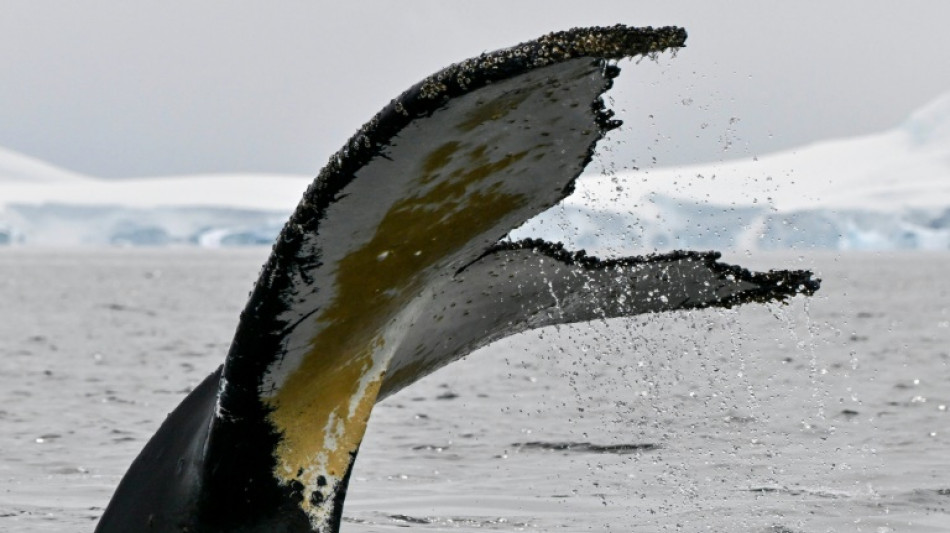
Whale of a tail: Scientists track unique humpback 'fingerprint' / Photo: Juan BARRETO - AFP

 Asian Games set to close after records, rancour and rain

 Cry for help as French-Swiss lake dries up

 Sabalenka swept out of China Open in third round

 US urges 'restraint' as Ethiopia's Tigray crisis rocks region

 Teens on target again as USA down Mexico 3-0

 World records prove Asian Games were a hit, says top official

 US prison chief who oversaw botched execution resigns

 'Chaotic' Asian Games threaten Japan hopes of hosting Olympics again

 Finnish town braces for change from Google data centres

 What is fuelling French school protests?

 Without lawyers, migrant children face deportation from the US

 Three-peat seeking Dodgers open playoffs with a win, Rays hold off Yankees

 Brazil votes in nail-biter polls closely watched by Trump

 'Just be you': Kim reveals Tiger text that inspired him to gold

 Myanmar migrants returned to war-torn nation from Malaysia

 ALEX BODI AND AMBASSADOR GUM DOMINIC MATIOK OF THE REPUBLIC OF SOUTH SUDAN MEET IN BERLIN TO DISCUSS THE POSSIBILITY OF AN HONORARY CONSULATE IN BUCHAREST

 Lula, Bolsonaro wrap up campaigns ahead of Brazil's knife-edge vote

 Toulouse edge Castres in Top 14 derby

 Murakami homer propels White Sox to MLB playoff win over Guardians

 Israel targets top Hamas leader in deadly Gaza strike on anniversary

 Houthis say struck oil facility near Riyadh, as Saudis hit Sanaa

 AI needs safety layers like nuclear plants: ex-OpenAI engineer

 MVP Judge will miss Yankees' MLB playoff series against Rays

 New lizard species discovered in Peru

 Fernandes hails Portugal's 'greatest symbol' Ronaldo, calls for unity

In Antarctica, a scientist waits patiently for two frolicking humpback whales to poke their tails out of the icy waters so she can take a photographic "fingerprint" of the unique colors and patterns that allow researchers to identify individuals of the species.
Andrea Bonilla, a Colombian scientist at Cornell University in the United States, has been working with a team of researchers since 2014 to catalog humpback whales from a visual analysis of their tails -- or flukes.
"What we are doing is tracking the history of each individual," Bonilla told AFP onboard the ARC Simon Bolivar during a scientific expedition by the Colombian navy.
Over the years, the team has identified 70 whales, and hopes to see some of them again to record any physical changes that could provide clues to their migratory patterns, population sizes, health and sexual maturity.
On the tail, "the coloration and patterns that each whale has is unique, it is like a fingerprint, so what we do is look at the different marks they have, the different scars" to identify an individual, said Bonilla.
Global populations of humpbacks have bounced back after once being decimated by commercial whaling, but the ocean giants remain under threat from vessel strikes, illegal fishing, pollution and underwater noise.
Today there are about 84,000 adult specimens in the world, according to the International Union for Conservation of Nature.
The importance of tail identification was highlighted in a study published last month in the Royal Society Open Science journal which showed the number of humpback whales in the North Pacific had plummeted 20 percent in less than a decade.
Tracking some 33,000 whales through photos of their flukes, scientists noted the steep decline which they speculate was due to starvation because of marine heat waves.
- 'Accumulating energy' -
Photo identification is common in the study of marine mammals, although the use of fluke identification is most used with humpbacks both because of their unique markings, and their habit of raising their tails out off the water while diving.
Different populations of humpback whales live across the world's oceans, carrying out mammoth migrations from warmer breeding spots to feeding grounds in polar waters.
"They take advantage of this great biomass of food that is here (in Antarctica) and for several months they are simply accumulating energy," said Bonilla.
Using photographs, the scientist draws reproductions of the details of the tails of the enormous marine mammals, which can reach up to 18 meters (59 feet) long and weigh about 40 tons.
On a computer, she zooms in on the details of the flukes, which can reveal attacks from other animals, "if there is some type of skin disease" or information about their diet.
The inventory allows scientists to track the movement of specific whales, which is crucial for conservation initiatives.
"If a whale always comes to the same area to reproduce, it is important to protect those areas. If they cease to exist or are disturbed, that whale will have nowhere to go," warned Bonilla.
H.Silva--PC



