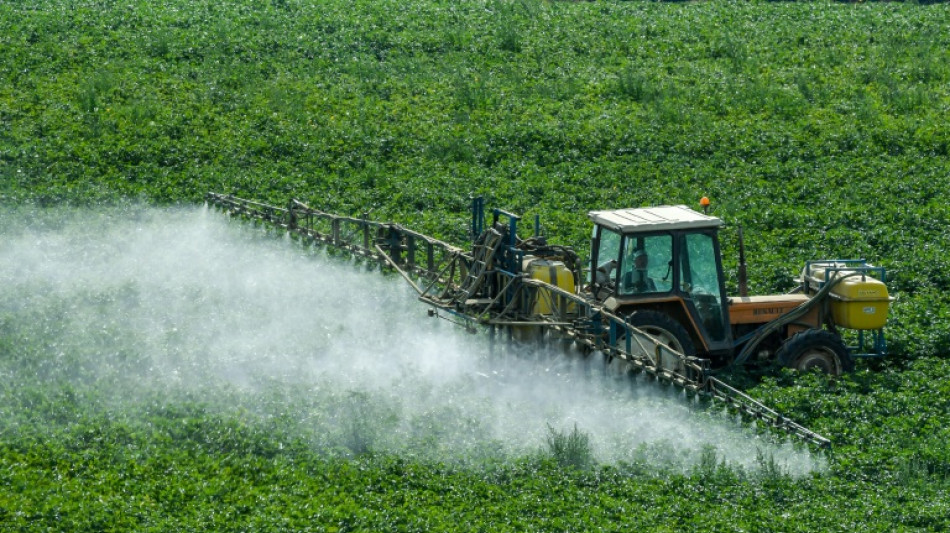
New research shows unintended harms of organic farming / Photo: Philippe HUGUEN - AFP/File

 Asian Games set to close after records, rancour and rain

 Cry for help as French-Swiss lake dries up

 Sabalenka swept out of China Open in third round

 US urges 'restraint' as Ethiopia's Tigray crisis rocks region

 Teens on target again as USA down Mexico 3-0

 World records prove Asian Games were a hit, says top official

 US prison chief who oversaw botched execution resigns

 'Chaotic' Asian Games threaten Japan hopes of hosting Olympics again

 Finnish town braces for change from Google data centres

 What is fuelling French school protests?

 Without lawyers, migrant children face deportation from the US

 Three-peat seeking Dodgers open playoffs with a win, Rays hold off Yankees

 Brazil votes in nail-biter polls closely watched by Trump

 'Just be you': Kim reveals Tiger text that inspired him to gold

 Myanmar migrants returned to war-torn nation from Malaysia

 ALEX BODI AND AMBASSADOR GUM DOMINIC MATIOK OF THE REPUBLIC OF SOUTH SUDAN MEET IN BERLIN TO DISCUSS THE POSSIBILITY OF AN HONORARY CONSULATE IN BUCHAREST

 Lula, Bolsonaro wrap up campaigns ahead of Brazil's knife-edge vote

 Toulouse edge Castres in Top 14 derby

 Murakami homer propels White Sox to MLB playoff win over Guardians

 Israel targets top Hamas leader in deadly Gaza strike on anniversary

 Houthis say struck oil facility near Riyadh, as Saudis hit Sanaa

 AI needs safety layers like nuclear plants: ex-OpenAI engineer

 MVP Judge will miss Yankees' MLB playoff series against Rays

 New lizard species discovered in Peru

 Fernandes hails Portugal's 'greatest symbol' Ronaldo, calls for unity

Organic farming is often touted as a more sustainable solution for food production, leveraging natural forms of pest control to promote eco-friendly cultivation.
But a new study published in Science on Thursday finds that expanding organic cropland can lead to increased pesticide use in surrounding non-organic fields, offsetting some environmental benefits.
These harmful "spillover effects" can be mitigated if organic farms are clustered together and geographically separated from conventional farms, the researchers found.
"Despite policy pushes to increase the amount of organic agriculture, there remain key knowledge gaps regarding how organic agriculture impacts the environment," said lead author Ashley Larsen, of the University of California, Santa Barbara.
Although organic agricultural practices generally improve environmental conditions such as soil and water quality, the trade-offs aren't very well understood.
For example, organic fields could harbor more beneficial species that prey on insects, such birds, spiders and predatory beetles and fewer pests. Or, the lack of chemical pesticides and genetically modified seeds could mean they harbor more pests.
To find out, Larsen and colleagues analyzed data on some 14,000 fields in Kern County, California, across seven years.
Kern County produces high-value crops including grapes, watermelons, citrus, tomatoes, potatoes and much more, making it one of the most valuable crop producing regions in the United States.
The team paired digitized maps of fields and the crops grown on them with records of pesticide applications and whether a field had an organic certification.
"Surrounding organic agriculture leads to an increase in pesticide use on conventional fields, but also leads to a larger decrease on nearby organic fields," said Larsen, with the effect manifesting primarily in insecticides, which specifically target insects.
The level of pesticides in conventional fields decreased the further away they were from organic fields.
But the situation could be completely remedied if organic fields were grouped together, the researchers found, based on a less-detailed national level analysis they also carried out.
"Spatially clustering organic fields and spatially separating organic and conventional fields could reduce the environmental footprint of both organic and conventional cropland," the team concluded.
Writing in a related commentary, Erik Lichtenberg of the University of Maryland said that the authors had shown farmers' decisions about pesticide are influenced by the presence of nearby organic fields -- but it's not fully clear why.
The value of the crops, their susceptibility to pests, and farmers' personal risk tolerances likely all play roles.
"Which mobile pests are involved, where they originate in the landscape, or how and why they move across the landscape are poorly understood," said Lichtenberg, calling for more research in this area.
A.Motta--PC



