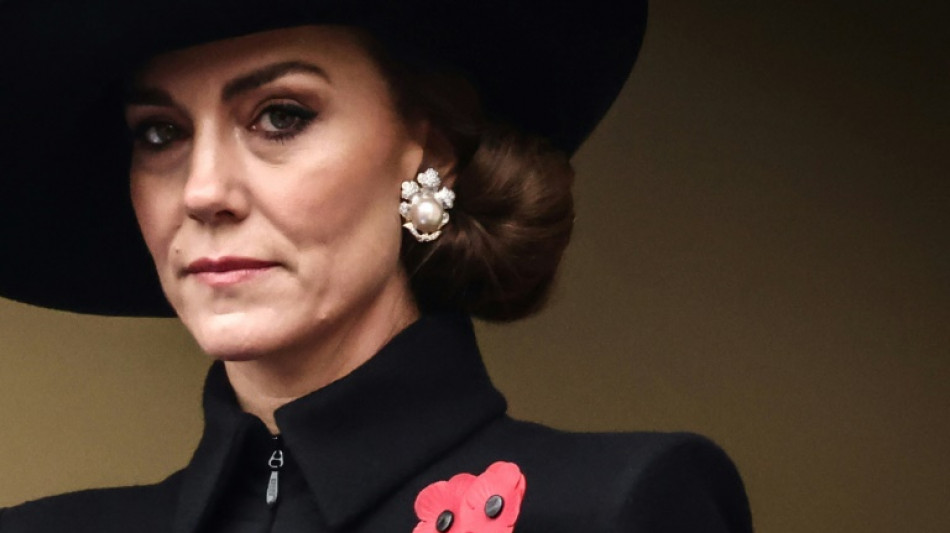
Princess Kate revelation shines light on under-50s cancer mystery / Photo: HENRY NICHOLLS - POOL/AFP/File

 Asian Games set to close after records, rancour and rain

 Cry for help as French-Swiss lake dries up

 Sabalenka swept out of China Open in third round

 US urges 'restraint' as Ethiopia's Tigray crisis rocks region

 Teens on target again as USA down Mexico 3-0

 World records prove Asian Games were a hit, says top official

 US prison chief who oversaw botched execution resigns

 'Chaotic' Asian Games threaten Japan hopes of hosting Olympics again

 Finnish town braces for change from Google data centres

 What is fuelling French school protests?

 Without lawyers, migrant children face deportation from the US

 Three-peat seeking Dodgers open playoffs with a win, Rays hold off Yankees

 Brazil votes in nail-biter polls closely watched by Trump

 'Just be you': Kim reveals Tiger text that inspired him to gold

 Myanmar migrants returned to war-torn nation from Malaysia

 ALEX BODI AND AMBASSADOR GUM DOMINIC MATIOK OF THE REPUBLIC OF SOUTH SUDAN MEET IN BERLIN TO DISCUSS THE POSSIBILITY OF AN HONORARY CONSULATE IN BUCHAREST

 Lula, Bolsonaro wrap up campaigns ahead of Brazil's knife-edge vote

 Toulouse edge Castres in Top 14 derby

 Murakami homer propels White Sox to MLB playoff win over Guardians

 Israel targets top Hamas leader in deadly Gaza strike on anniversary

 Houthis say struck oil facility near Riyadh, as Saudis hit Sanaa

 AI needs safety layers like nuclear plants: ex-OpenAI engineer

 MVP Judge will miss Yankees' MLB playoff series against Rays

 New lizard species discovered in Peru

 Fernandes hails Portugal's 'greatest symbol' Ronaldo, calls for unity

When Catherine, Princess of Wales, revealed she was being treated for cancer last week, part of the shock was that an otherwise healthy 42-year-old has a disease that mostly plagues older people.
However, researchers have been increasingly sounding the alarm that more and more people under 50 are getting cancer -- and no one knows why.
Across the world, the rate of under-50s diagnosed with 29 common cancers surged by nearly 80 percent between 1990 and 2019, a large study in BMJ Oncology found last year.
The researchers predicted the number of new cancer cases among younger adults will rise another 30 percent by the end of this decade, with wealthy countries particularly affected.
The increase in cases -- and soaring global population -- means that the number of deaths among under 50s from cancer has risen by nearly 28 percent over the last 30 years.
This occurred even as the odds of people of all ages surviving cancer have roughly doubled over the last half century.
Shivan Sivakumar, a cancer researcher at the UK's University of Birmingham, called it an "epidemic" of young adult cancer.
Since Kate Middleton revealed on Friday that her cancer was discovered after she received abdominal surgery earlier this year, Sivakumar and other doctors have spoken out about the uptick in younger cancer patients they have been seeing at their clinics.
While breast cancer remains the most common for people under 50, the researchers expressed particular concern about the rise of gastrointestinal cancers -- such as of the colon, pancreas, liver and oesophagus -- in younger adults.
Colon cancer is now the leading cause of cancer deaths in men under 50 in the United States, according to the American Cancer Society. For women, it is number two -- behind only breast cancer.
One high profile case of colorectal cancer was "Black Panther" actor Chadwick Boseman, who died at the age of 43 in 2020.
- Why is this happening? -
"We just don't have the evidence yet" to say exactly what is causing this rise, Sivakumar told AFP, adding it was likely a combination of factors.
Helen Coleman, a cancer epidemiology professor at Queen's University Belfast who has studied early onset cancer in Northern Ireland, told AFP there were two potential explanations.
One is that people in their 40s were exposed to factors known to cause cancer -- such tobacco smoke, alcohol or being obese -- at an earlier age than previous generations.
She pointed out that the "obesity epidemic" did not start until the 1980s.
Sivakumar felt that at least part of the puzzle could be explained by obesity.
However, there is "another wave" of under-50 patients who are neither obese nor genetically predisposed still getting cancer, he emphasised, adding that this could not be put down to "statistical chance".
The other theory, Coleman said, is that "something different" has been going on with her generation.
Fingers have been pointed out a range of possible culprits -- including chemicals, new drugs and microplastics -- but none have been proven.
Some have suggested that so-called ultra-processed foods could be to blame. "But there's very little data to back any of that up," Coleman said.
Another theory is that the food we eat could be changing our gut microbiome.
While there is nothing conclusive yet, Coleman said her own research suggested that cancer causes changes to the microbiome, not the other way around.
Anti-vaxx conspiracy theorists have even tried to blame Covid-19 vaccines.
This is easily disproven, because the rise in young adult cancer has taken place over decades, but the vaccines have only been around for a few years.
- What can be done? -
To address the rise in younger colorectal cancer, in 2021 the US lowered the recommended age for screening to 45. Other countries have yet to follow suit.
But the researchers hoped that Catherine's experience would remind people at home that they should consult their doctor if they sense anything is wrong.
"People know their bodies really well," Sivakumar said.
"If you really feel that something isn't right, don't delay -- just get yourself checked out."
L.Henrique--PC



