Song lyrics are getting simpler, more repetitive: study / Photo: - - AFP/File

 Asian Games set to close after records, rancour and rain

 Cry for help as French-Swiss lake dries up

 Sabalenka swept out of China Open in third round

 US urges 'restraint' as Ethiopia's Tigray crisis rocks region

 Teens on target again as USA down Mexico 3-0

 World records prove Asian Games were a hit, says top official

 US prison chief who oversaw botched execution resigns

 'Chaotic' Asian Games threaten Japan hopes of hosting Olympics again

 Finnish town braces for change from Google data centres

 What is fuelling French school protests?

 Without lawyers, migrant children face deportation from the US

 Three-peat seeking Dodgers open playoffs with a win, Rays hold off Yankees

 Brazil votes in nail-biter polls closely watched by Trump

 'Just be you': Kim reveals Tiger text that inspired him to gold

 Myanmar migrants returned to war-torn nation from Malaysia

 ALEX BODI AND AMBASSADOR GUM DOMINIC MATIOK OF THE REPUBLIC OF SOUTH SUDAN MEET IN BERLIN TO DISCUSS THE POSSIBILITY OF AN HONORARY CONSULATE IN BUCHAREST

 Lula, Bolsonaro wrap up campaigns ahead of Brazil's knife-edge vote

 Toulouse edge Castres in Top 14 derby

 Murakami homer propels White Sox to MLB playoff win over Guardians

 Israel targets top Hamas leader in deadly Gaza strike on anniversary

 Houthis say struck oil facility near Riyadh, as Saudis hit Sanaa

 AI needs safety layers like nuclear plants: ex-OpenAI engineer

 MVP Judge will miss Yankees' MLB playoff series against Rays

 New lizard species discovered in Peru

 Fernandes hails Portugal's 'greatest symbol' Ronaldo, calls for unity

You're not just getting older. Song lyrics really are becoming simpler and more repetitive, according to a study published on Thursday.
Lyrics have also become angrier and more self-obsessed over the last 40 years, the study found, reinforcing the opinions of cranky ageing music fans everywhere.
A team of European researchers analysed the words in more than 12,000 English-language songs across the genres of rap, country, pop, R&B and rock from 1980 to 2020.
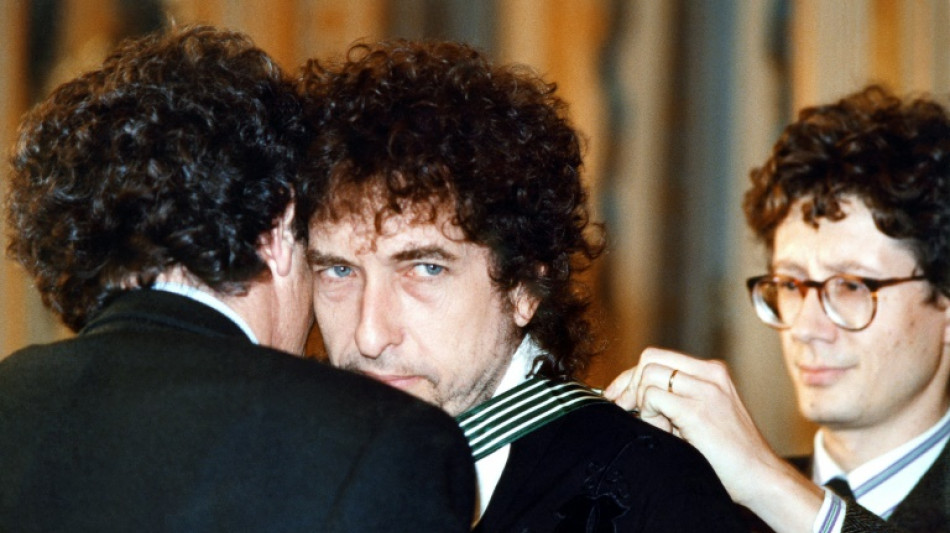
Before detailing how lyrics have become more basic, the study pointed out that US singer-songwriting legend Bob Dylan -- who rose to fame in the 1960s -- has won a Nobel Prize in literature.
Senior study author Eva Zangerle, an expert on recommendation systems at Austria's University of Innsbruck, declined to single out an individual newer artist for having simple lyrics.
But she emphasised that lyrics can be a "mirror of society" which reflect how a culture's values, emotions and preoccupations change over time.
"What we have also been witnessing in the last 40 years is a drastic change in the music landscape -- from how music is sold to how music is produced," Zangerle told AFP.
Over the 40 years studied, there was repeated upheaval in how people listened to music. The vinyl records and cassette tapes of the 1980s gave way to the CDs of the 90s, then the arrival of the internet led to the algorithm-driven streaming platforms of today.
For the study in the journal Scientific Reports, the researchers looked at the emotions expressed in lyrics, how many different and complicated words were used, and how often they were repeated.
"Across all genres, lyrics had a tendency to become more simple and more repetitive," Zangerle summarised.
The results also confirmed previous research which had shown a decrease in positive, joyful lyrics over time and a rise in those that express anger, disgust or sadness.
Lyrics have also become much more self-obsessed, with words such as "me" or "mine" becoming much more popular.
- 'Easier to memorise' -
The number of repeated lines rose most in rap over the decades, Zangerle said -- adding that it obviously had the most lines to begin with.
"Rap music has become more angry than the other genres," she added.
The researchers also investigated which songs the fans of different genres looked up on the lyric website Genius.
Unlike other genres, rock fans most often looked up lyrics from older songs, rather than new ones.
Rock has tumbled down the charts in recent decades, and this could suggest fans are increasingly looking back to the genre's heyday, rather than its present.
Another way that music has changed is that "the first 10-15 seconds are highly decisive for whether we skip the song or not," Zangerle said.
Previous research has also suggested that people tend to listen to music more in the background these days, she added.
Put simply, songs with more choruses that repeat basic lyrics appear to be more popular.
"Lyrics should stick easier nowadays, simply because they are easier to memorise," Zangerle said.
"This is also something that I experience when I listen to the radio."
P.Queiroz--PC



