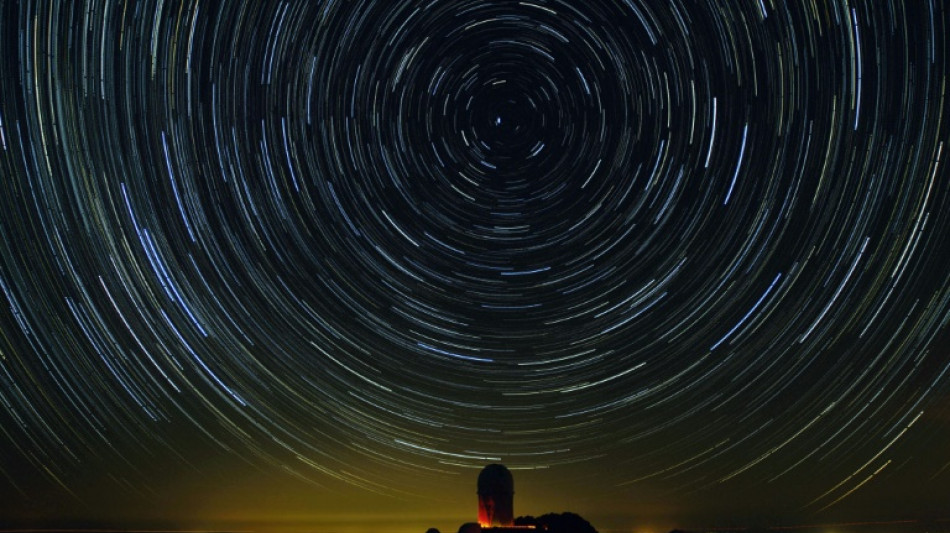
The universe's accelerated expansion might be slowing down / Photo: STAN HONDA - AFP/File

 Asian Games set to close after records, rancour and rain

 Cry for help as French-Swiss lake dries up

 Sabalenka swept out of China Open in third round

 US urges 'restraint' as Ethiopia's Tigray crisis rocks region

 Teens on target again as USA down Mexico 3-0

 World records prove Asian Games were a hit, says top official

 US prison chief who oversaw botched execution resigns

 'Chaotic' Asian Games threaten Japan hopes of hosting Olympics again

 Finnish town braces for change from Google data centres

 What is fuelling French school protests?

 Without lawyers, migrant children face deportation from the US

 Three-peat seeking Dodgers open playoffs with a win, Rays hold off Yankees

 Brazil votes in nail-biter polls closely watched by Trump

 'Just be you': Kim reveals Tiger text that inspired him to gold

 Myanmar migrants returned to war-torn nation from Malaysia

 ALEX BODI AND AMBASSADOR GUM DOMINIC MATIOK OF THE REPUBLIC OF SOUTH SUDAN MEET IN BERLIN TO DISCUSS THE POSSIBILITY OF AN HONORARY CONSULATE IN BUCHAREST

 Lula, Bolsonaro wrap up campaigns ahead of Brazil's knife-edge vote

 Toulouse edge Castres in Top 14 derby

 Murakami homer propels White Sox to MLB playoff win over Guardians

 Israel targets top Hamas leader in deadly Gaza strike on anniversary

 Houthis say struck oil facility near Riyadh, as Saudis hit Sanaa

 AI needs safety layers like nuclear plants: ex-OpenAI engineer

 MVP Judge will miss Yankees' MLB playoff series against Rays

 New lizard species discovered in Peru

 Fernandes hails Portugal's 'greatest symbol' Ronaldo, calls for unity

The universe is still expanding at an accelerating rate, but it may have slowed down recently compared to a few billion years ago, early results from the most precise measurement of its evolution yet suggested Thursday.
While the preliminary findings are far from confirmed, if they hold up it would further deepen the mystery of dark energy -- and likely mean there is something important missing in our understanding of the cosmos.
These signals of our universe's changing speeds were spotted by the Dark Energy Spectroscopic Instrument (DESI), which is perched atop a telescope at the Kitt Peak National Observatory in the US state of Arizona.
Each of the instrument's 5,000 fibre-optic robots can observe a galaxy for 20 minutes, allowing astronomers to chart what they have called the largest-ever 3D map of the universe.
"We measured the position of the galaxies in space but also in time, because the further away they are, the more we go back in time to a younger and younger universe," Arnaud de Mattia, a co-leader of the DESI data interpretation team, told AFP.
Just one year into its five-year survey, DESI has already drawn up a map which includes six million galaxies and quasars using light that stretches up to 11 billion years into the universe's past.
The results were announced at conferences in the United States and Switzerland on Thursday, ahead of a series of scientific papers being published in the Journal of Cosmology and Astroparticle Physics.
DESI is on a mission to shed light on the nature of dark energy -- a theoretical phenomenon thought to make up roughly 70 percent of the universe.
Another 25 percent of the universe is composed of the equally mysterious dark matter, leaving just five percent of normal matter -- such as everything you can see.
- An inconstant constant? -
For more than a century, scientists have known that the universe started expanding after the Big Bang, 13.8 billion years ago.
But in the late 1990s, astronomers were shocked to discover it has been expanding at an ever-increasing rate.
This was a surprise because gravity from matter -- both normal and dark -- was thought to have been slowing the universe down.
But obviously something was making the universe expand at ever-faster speeds, and the name "dark energy" was given to this force.
More recently, it was discovered that the acceleration of the universe significantly sped up around six billion years after the Big Bang.
In the push-and-pull between matter and dark energy, the latter certainly seems to have the upper hand, according to the leading model of the universe called the Lambda CDM.
Under this model, the quickening expansion of the universe is called the "cosmological constant," which is closely linked to dark energy.
DESI director Michael Levi said that so far, the instrument's early results were showing "basic agreement with our best model of the universe".
"But we're also seeing some potentially interesting differences which could indicate that dark energy is evolving with time," Levi said in a statement.
In other words, the data "seems to show that the cosmological constant Lambda is not really a constant," because dark energy would be displaying "dynamic" and changing behaviour, De Mattia said.
- Slowing down in old age -
This could suggest that -- after switching into high gear six billion years after the Big Bang -- the speed at which the universe has been expanding has been "slowing down in recent times," DESI researcher Christophe Yeche said.
Whether dark energy does in fact change over time would need to be verified by more data from DESI and other instruments, such as the space telescope Euclid.
But if it was confirmed, our understanding of the universe will likely have to be changed to accommodate for this strange behaviour.
For example, the cosmological constant could be replaced by some kind of field linked to some as-yet-unknown particle.
It could even necessitate updating the equations of Einstein's theory of relativity "so that they behave slightly differently on the scale of large structures," De Mattia said.
But we are not there yet.
The history of science is full of examples in which "deviations of this type have been observed then resolved over time," De Mattia emphasised.
After all, Einstein's theory of relativity has withstood more than a century of scientific poking and prodding and still stands stronger than ever.
X.M.Francisco--PC



