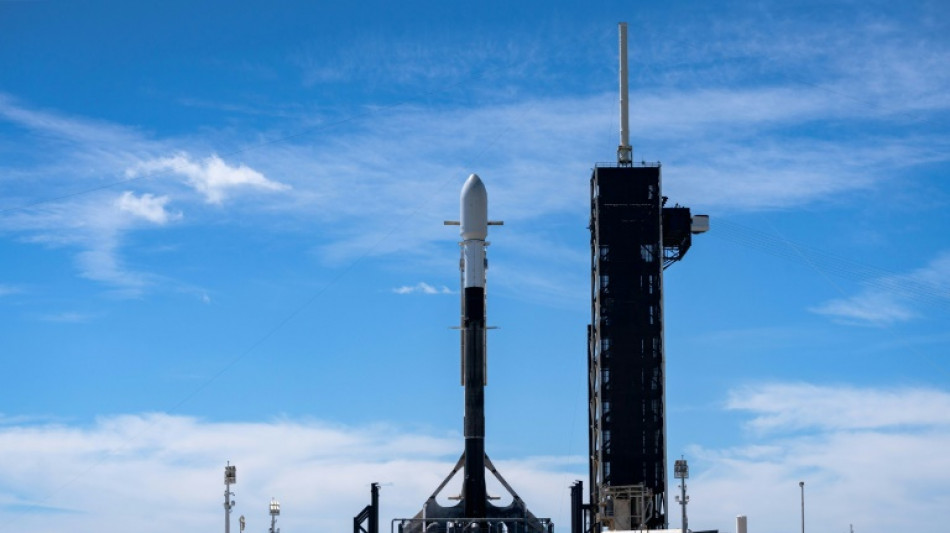
S. Korea says second spy satellite placed in orbit / Photo: Handout - South Korean Defence Ministry/AFP

 Asian Games set to close after records, rancour and rain

 Cry for help as French-Swiss lake dries up

 Sabalenka swept out of China Open in third round

 US urges 'restraint' as Ethiopia's Tigray crisis rocks region

 Teens on target again as USA down Mexico 3-0

 World records prove Asian Games were a hit, says top official

 US prison chief who oversaw botched execution resigns

 'Chaotic' Asian Games threaten Japan hopes of hosting Olympics again

 Finnish town braces for change from Google data centres

 What is fuelling French school protests?

 Without lawyers, migrant children face deportation from the US

 Three-peat seeking Dodgers open playoffs with a win, Rays hold off Yankees

 Brazil votes in nail-biter polls closely watched by Trump

 'Just be you': Kim reveals Tiger text that inspired him to gold

 Myanmar migrants returned to war-torn nation from Malaysia

 ALEX BODI AND AMBASSADOR GUM DOMINIC MATIOK OF THE REPUBLIC OF SOUTH SUDAN MEET IN BERLIN TO DISCUSS THE POSSIBILITY OF AN HONORARY CONSULATE IN BUCHAREST

 Lula, Bolsonaro wrap up campaigns ahead of Brazil's knife-edge vote

 Toulouse edge Castres in Top 14 derby

 Murakami homer propels White Sox to MLB playoff win over Guardians

 Israel targets top Hamas leader in deadly Gaza strike on anniversary

 Houthis say struck oil facility near Riyadh, as Saudis hit Sanaa

 AI needs safety layers like nuclear plants: ex-OpenAI engineer

 MVP Judge will miss Yankees' MLB playoff series against Rays

 New lizard species discovered in Peru

 Fernandes hails Portugal's 'greatest symbol' Ronaldo, calls for unity

South Korea put its second domestically made spy satellite into orbit, Seoul's defence ministry said Monday, after it launched from an American space centre on a SpaceX Falcon 9 rocket.
The satellite successfully communicated with an overseas ground station shortly afterwards, the ministry said.
"Our military's second reconnaissance satellite successfully separated from the launch vehicle at around 09:02 (1202 GMT) and entered the target orbit," the defence ministry said in a statement.
The satellite "successfully established contact with an overseas ground station at approximately 10:57 (0157 GMT)", it added.
Seoul's military said its "independent intelligence, surveillance and reconnaissance capabilities have been further strengthened," by the successful launch.
"We will proceed with future satellite launches without a hitch," it added.
Seoul launched its first military spy satellite in December, which was also carried by one of Elon Musk's SpaceX Falcon 9 rockets.
The latest developments intensify a space race on the Korean peninsula after North Korea launched its first military eye in the sky last November.
Seoul's defence minister said the military was closely monitoring the North for further satellite launches, which it had originally expected in March.
"It seems they are taking additional supplementary measures," Defence Minister Shin Won-sik said after the launch, adding that an April launch by Pyongyang seemed likely.
"If these measures proceed without issue, a mid-April launch is highly possible. April 15 holds special significance for North Korea, so they might attempt a launch then," he said.
April 15 is the birthday of the North's founding leader Kim Il Sung, and is celebrated as Day of the Sun in the country, typically marked with military parades or other mass events.
"It's also reasonable to extend the window to late April to ensure all supplementary measures are fully implemented," Shin said.
- Five more -
South Korea's first satellite has transmitted high-resolution images of central Pyongyang to Seoul and is expected to commence its full mission stages as early as June, according to Yonhap news agency.
Seoul plans to launch a total of five military spy satellites by 2025 to better monitor the North.
Once all five enter orbit and commence their missions, the South Korean military will have the capability to monitor key facilities in North Korea using imagery sent around every two hours, according to a report by Seoul's government-run broadcaster KTV.
North Korea has claimed its spy satellite has sent images of a US naval base at Hawaii's Pearl Harbor and "major target" sites across South Korea.
The North's launch of the "Malligyong-1" was Pyongyang's third attempt at putting such a satellite into orbit, after two failures in May and August last year.
Seoul has said the North received technical help from Russia for the launch in return for weapons for use in the war in Ukraine.
Experts have said putting a working reconnaissance satellite into orbit would improve North Korea's intelligence-gathering capabilities, particularly over South Korea, and provide crucial data in any military conflict.
Pyongyang this year has declared South Korea its "principal enemy", jettisoned agencies dedicated to reunification and outreach, and threatened war over "even 0.001 mm" of territorial infringement.
J.Oliveira--PC



