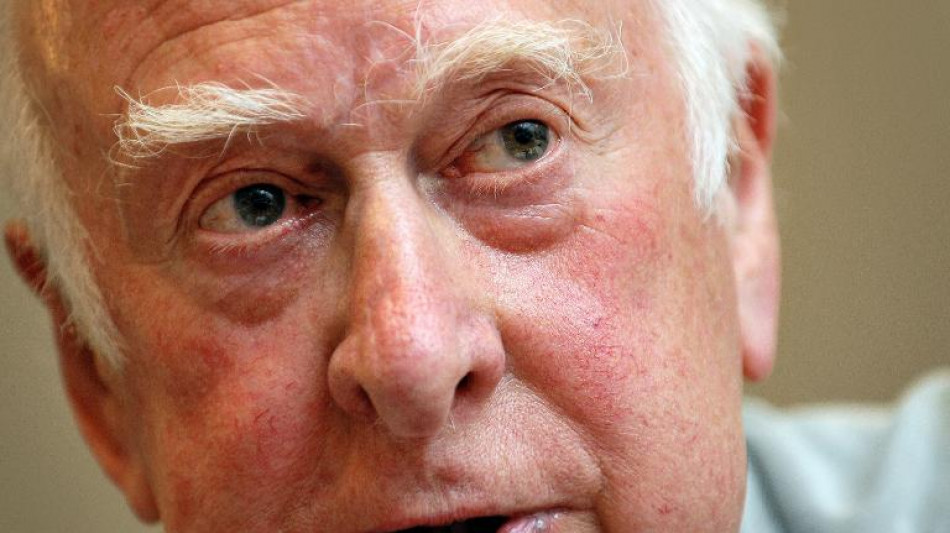
Peter Higgs: physicist who predicted 'God particle' / Photo: Fabrice Coffrini - POOL/AFP/File

 Asian Games set to close after records, rancour and rain

 Cry for help as French-Swiss lake dries up

 Sabalenka swept out of China Open in third round

 US urges 'restraint' as Ethiopia's Tigray crisis rocks region

 Teens on target again as USA down Mexico 3-0

 World records prove Asian Games were a hit, says top official

 US prison chief who oversaw botched execution resigns

 'Chaotic' Asian Games threaten Japan hopes of hosting Olympics again

 Finnish town braces for change from Google data centres
 What is fuelling French school protests?

 Without lawyers, migrant children face deportation from the US

 Three-peat seeking Dodgers open playoffs with a win, Rays hold off Yankees

 Brazil votes in nail-biter polls closely watched by Trump

 'Just be you': Kim reveals Tiger text that inspired him to gold

 Myanmar migrants returned to war-torn nation from Malaysia

 ALEX BODI AND AMBASSADOR GUM DOMINIC MATIOK OF THE REPUBLIC OF SOUTH SUDAN MEET IN BERLIN TO DISCUSS THE POSSIBILITY OF AN HONORARY CONSULATE IN BUCHAREST

 Lula, Bolsonaro wrap up campaigns ahead of Brazil's knife-edge vote

 Toulouse edge Castres in Top 14 derby

 Murakami homer propels White Sox to MLB playoff win over Guardians

 Israel targets top Hamas leader in deadly Gaza strike on anniversary

 Houthis say struck oil facility near Riyadh, as Saudis hit Sanaa

 AI needs safety layers like nuclear plants: ex-OpenAI engineer

 MVP Judge will miss Yankees' MLB playoff series against Rays

 New lizard species discovered in Peru

 Fernandes hails Portugal's 'greatest symbol' Ronaldo, calls for unity

Nobel laureate Peter Higgs gave his name to one of the great scientific discoveries of the last century, earning a place alongside Albert Einstein and Max Planck in physics textbooks.
Through ground-breaking theoretical work, Higgs, who died on Monday aged 94, helped explain how the Universe has mass, resolving one of the greatest puzzles in physics.
His 1964 theory of a mass-giving particle, which became known as the Higgs boson or the "God particle", earned him and Belgian physicist Francois Englert the 2013 Nobel Prize for Physics.
But when the announcement for which he had been waiting for half a century came, the unassuming physicist was nowhere to be found, having slipped out his back door into a pub, according to the 2022 biography "Elusive".
Higgs later admitted that the sudden fame was "a bit of a nuisance".
Announcing his death on Tuesday, the University of Edinburgh -- where he had taught and researched in various capacities since the 1950s -- hailed him a "great teacher and mentor".
It said he had inspired "generations of young scientists".
- 'Oh shit, I know...' -
The Higgs boson confers mass on some of the fundamental particles that make up matter.
Without it, theorists explain, we and all the other connected atoms in the universe would not exist.
Shy and unassuming, Higgs had seen the light almost half a century before the particle's existence was confirmed by the European Organisation for Nuclear Research (CERN) in Geneva in July 2012 in the Large Hadron Collider.
He realised in a eureka moment as a young lecturer in 1946 there could be a field of novel particles that confers mass.
"He said: 'Oh shit, I know how to do that!'" former colleague and friend Alan Walker told AFP of the breakthrough as recounted to him by Higgs.
Higgs published a paper on his theory in 1964, becoming the flag bearer of a premise to which several scientists had contributed over the years, including Englert, but which, at the outset, found few backers.
Particularly sceptical was CERN, which embarked on a years-long, multi-billion-dollar quest to find the needle-in-a-haystack particle, culminating in its own eureka moment on July 4, 2012.
Higgs was present in Geneva to hear CERN announce that it had found a particle "consistent" with the elusive boson.
"It's very nice to be right sometimes. It has certainly been a long wait," he declared.
He and Englert won a slew of awards for their work, including the prestigious Wolf Prize in 2004.
But Higgs revealed he had turned down a knighthood, saying he felt the British honours system was "used for political purposes."
- 'Gentle' -
Higgs was born in Newcastle upon Tyne, in northeastern England, on May 29, 1929, to a Scottish mother and an English father who worked as a sound engineer at the BBC.
He studied at King's College in London, gaining a PhD in 1954, and went on to lecture at Edinburgh University.
Balding and ruddy-cheeked, he retired in 1996 and continued to live quietly in the Scottish capital, where he was emeritus professor of theoretical physics.
A modest man, who published only around a dozen scientific papers over his career, he cringed every time the term "Higgs boson" was used in his presence.
But as a life-long atheist, he disliked the "God particle" even more.
"He is a very mild-mannered and very gentle man, but he actually does get a little tenacious if you say something wrong that (has to do with) physics," his former colleague and friend Walker once said.
Others credited with contributing to the Higgs theory include Americans Gerald Guralnik, Carl Hagen, and Briton Tom Kibble, who jointly did a separate paper on the mechanism in the same year as Higgs.
Higgs married American linguist Jody Williamson, with whom he had two children. The pair later separated but remained close until her death in 2008 of leukemia.
He campaigned against nuclear weapons, joining a call in 2015 for Britain to abandon its Trident nuclear deterrent.
Ferreira--PC



