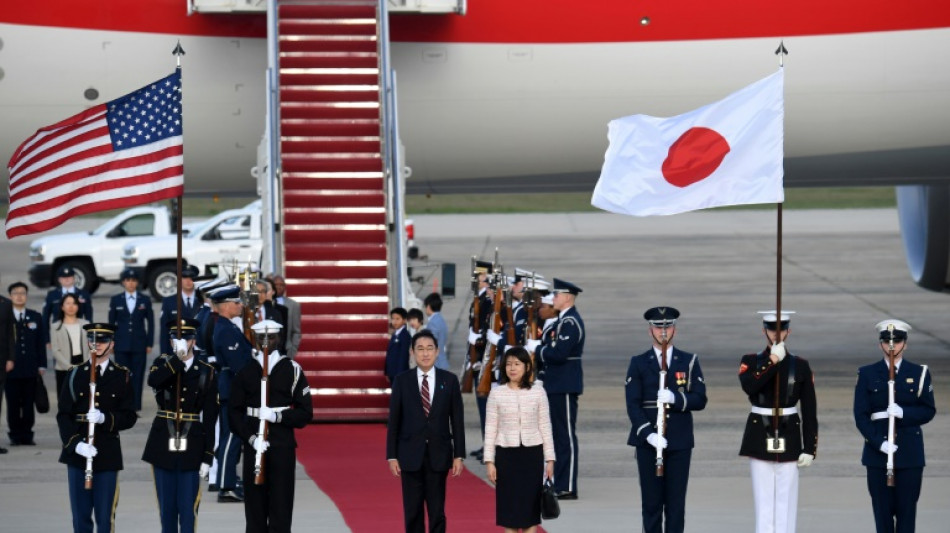
Microsoft to invest $2.9 bn in Japan AI push / Photo: OLIVIER DOULIERY - AFP

 Asian Games set to close after records, rancour and rain

 Cry for help as French-Swiss lake dries up

 Sabalenka swept out of China Open in third round

 US urges 'restraint' as Ethiopia's Tigray crisis rocks region

 Teens on target again as USA down Mexico 3-0

 World records prove Asian Games were a hit, says top official

 US prison chief who oversaw botched execution resigns

 'Chaotic' Asian Games threaten Japan hopes of hosting Olympics again

 Finnish town braces for change from Google data centres

 What is fuelling French school protests?

 Without lawyers, migrant children face deportation from the US

 Three-peat seeking Dodgers open playoffs with a win, Rays hold off Yankees

 Brazil votes in nail-biter polls closely watched by Trump

 'Just be you': Kim reveals Tiger text that inspired him to gold

 Myanmar migrants returned to war-torn nation from Malaysia

 ALEX BODI AND AMBASSADOR GUM DOMINIC MATIOK OF THE REPUBLIC OF SOUTH SUDAN MEET IN BERLIN TO DISCUSS THE POSSIBILITY OF AN HONORARY CONSULATE IN BUCHAREST

 Lula, Bolsonaro wrap up campaigns ahead of Brazil's knife-edge vote

 Toulouse edge Castres in Top 14 derby

 Murakami homer propels White Sox to MLB playoff win over Guardians

 Israel targets top Hamas leader in deadly Gaza strike on anniversary

 Houthis say struck oil facility near Riyadh, as Saudis hit Sanaa

 AI needs safety layers like nuclear plants: ex-OpenAI engineer

 MVP Judge will miss Yankees' MLB playoff series against Rays

 New lizard species discovered in Peru

 Fernandes hails Portugal's 'greatest symbol' Ronaldo, calls for unity

Microsoft on Tuesday announced a $2.9 billion investment over the next two years in Japan to bolster the country's push into artificial intelligence and strengthen its cyber defences in the face of threats from China and Russia.
The announcement coincides with Japanese Prime Minister Fumio Kishida's visit to Washington, underscoring Tokyo's commitment to becoming a major AI power.
Japan is also expanding its semiconductor industry with the help of big foreign investment. Taiwanese chip behemoth TSMC opened a new $8.6-billion chip factory in southern Japan in February, and is planning a second facility.
Microsoft has become a major player in the advancement of AI through its partnership with ChatGPT-maker OpenAI -- propelling it past Apple as the world's biggest company by market capitalisation.
"This is Microsoft's single largest investment in its 46-year history in Japan," said Brad Smith, Vice Chair and President of Microsoft, who met Kishida on Tuesday.
"These investments are essential ingredients for Japan to build a robust AI economy."
The investment includes providing "more advanced computing resources", according to Smith, including powerful graphics processing units crucial for running AI applications.
Microsoft also pledged to invest in training three million Japanese workers in AI skills over the next three years, and announced the opening of its first Microsoft Research Asia lab in Tokyo that will work on AI and robotics.
The US company also unveiled plans to collaborate with Japan's government to strengthen the country's cybersecurity following an increase in hacking and breaches.
"The threat landscape for cybersecurity has become more challenging," Smith told the Nikkei news outlet.
"We're seeing that from China and from Russia in particular, but we're also seeing growing ransomware activity around the world."
Google in March also launched a new cybersecurity hub in Japan, aimed at helping to upgrade defences in the Asia-Pacific.
Kishida will meet President Joe Biden on Wednesday with defence ties high on the agenda, but also cooperation in technology from space to semiconductors.
Motivated by geopolitical concerns surrounding Taiwan, Tokyo is seeking to bring back the 1980s glory days when Japanese firms such as Toshiba and NEC dominated the microchip market.
As well as the TSMC plants, Japan is ploughing around $6 billion into its next-generation semiconductor venture called Rapidus, involving a host of Japanese firms including Sony and Toyota.
Rapidus is collaborating with US giant IBM with the aim of mass-producing two-nanometre logic chips in Japan from 2027.
On Tuesday, alongside Microsoft's investment, two new AI research partnerships were announced between four US and Japanese universities.
The research programmes, funded by tech firms including Nvidia, Amazon, Arm and SoftBank Group as well as Microsoft, "can help set the standard in this fast-evolving field", US Ambassador Rahm Emanuel said.
Rene Haas, CEO of British chip designer Arm, also hailed the "historic" new university partnerships.
"The unprecedented progress we've seen in AI will transform virtually every industry and improve countless lives," he said.
M.Gameiro--PC



