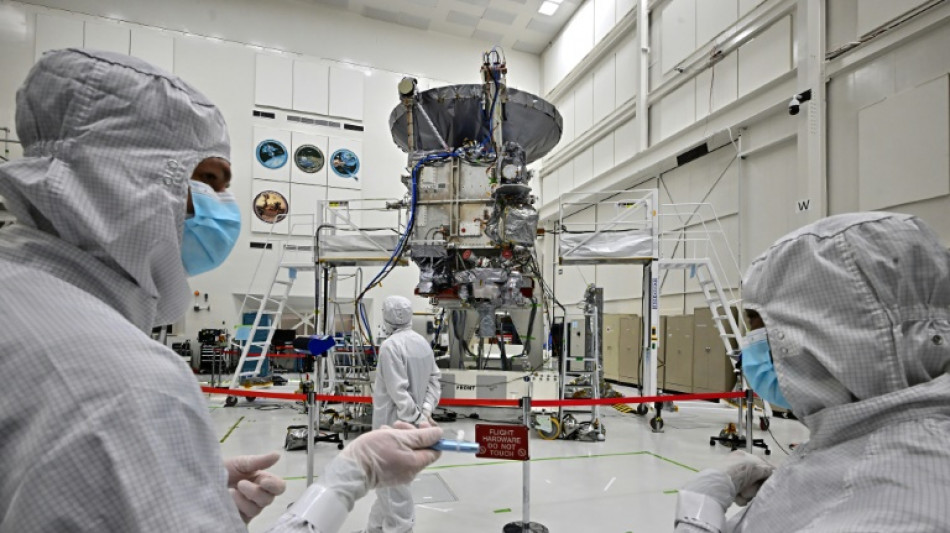
NASA unveils probe bound for Jupiter's possibly life-sustaining moon / Photo: Frederic J. Brown - AFP

 Asian Games set to close after records, rancour and rain

 Cry for help as French-Swiss lake dries up

 Sabalenka swept out of China Open in third round

 US urges 'restraint' as Ethiopia's Tigray crisis rocks region

 Teens on target again as USA down Mexico 3-0

 World records prove Asian Games were a hit, says top official

 US prison chief who oversaw botched execution resigns

 'Chaotic' Asian Games threaten Japan hopes of hosting Olympics again

 Finnish town braces for change from Google data centres

 What is fuelling French school protests?

 Without lawyers, migrant children face deportation from the US

 Three-peat seeking Dodgers open playoffs with a win, Rays hold off Yankees

 Brazil votes in nail-biter polls closely watched by Trump

 'Just be you': Kim reveals Tiger text that inspired him to gold

 Myanmar migrants returned to war-torn nation from Malaysia

 ALEX BODI AND AMBASSADOR GUM DOMINIC MATIOK OF THE REPUBLIC OF SOUTH SUDAN MEET IN BERLIN TO DISCUSS THE POSSIBILITY OF AN HONORARY CONSULATE IN BUCHAREST

 Lula, Bolsonaro wrap up campaigns ahead of Brazil's knife-edge vote

 Toulouse edge Castres in Top 14 derby

 Murakami homer propels White Sox to MLB playoff win over Guardians

 Israel targets top Hamas leader in deadly Gaza strike on anniversary

 Houthis say struck oil facility near Riyadh, as Saudis hit Sanaa

 AI needs safety layers like nuclear plants: ex-OpenAI engineer

 MVP Judge will miss Yankees' MLB playoff series against Rays

 New lizard species discovered in Peru

 Fernandes hails Portugal's 'greatest symbol' Ronaldo, calls for unity

US space scientists on Thursday unveiled the interplanetary probe NASA plans to send to one of Jupiter's icy moons as part of humanity's hunt for extra-terrestrial life.
The Clipper spacecraft is due to blast off in October bound for Europa, one of dozens of moons orbiting the Solar System's biggest planet, and the nearest spot in our celestial neighborhood that could offer a perch for life.
"One of the fundamental questions that NASA wants to understand is, are we alone in the cosmos?" Bob Pappalardo, the mission's project scientist told AFP.
"If we were to find the conditions for life, and then someday actually find life in a place like Europa, then that would say in our own solar system there are two examples of life: Earth and Europa.
"That would be huge for understanding how common life might be throughout the universe."
The $5 billion probe is currently at NASA's Jet Propulsion Laboratory in California, sitting in a "clean room" -- a sealed area only accessible to people wearing head-to-toe covering.
The precautions are to ensure the probe remains free of contaminants to avoid transporting Earthly microbes to Europa.
After transport to Kennedy Space Center in Florida, Clipper is set to launch aboard a Space X Falcon Heavy rocket and begin an over-five-year journey that involves a pass by Mars to pick up speed.
In 2031, it should be in orbit around Jupiter and Europa, where it will begin a detailed study of the moon scientists believe is covered in frozen water.
"We have instruments like cameras, and spectrometers, a magnetometer and a radar that can... penetrate right through ice, bounce off liquid water and back to the surface to tell us how thick is the ice and where is liquid water located," Pappalardo said.
Mission managers do not expect to find little green men swimming in the water -- in fact, they're not even looking for life itself, only for the conditions that could support it.
Scientists know from extreme environments on Earth -- like light-starved geothermal vents located deep under the polar ice cap -- that tiny beings can find purchase almost anywhere.
And conditions on Europa, which is almost as large as Earth's moon, could provide a similar habitat, offering the tantalizing prospect we are not alone -- not even in our own Solar System.
"If moons around planets far away from stars could hold life, then the number of opportunities around the solar system, around the universe, where life could take hold, I think goes up dramatically," said Jordan Evans, project manager for the Europa Clipper mission.
- Challenges -
The science is not easy -- a powerful radiation field around Europa could degrade the instruments, which will be getting the equivalent of 100,000 chest x-rays every circuit around the moon.
The vast distances involved mean that when Clipper sends its data back, the signal will take 45 minutes to arrive at Mission Control.
And despite its massive solar array, which unfurls once in space, keeping Clipper powered will be a major challenge, Evans said.
"Right after launch, (the solar panels are) putting out 23,000 watts... but when we're out at Jupiter, so far away from the Sun, they're only putting out 700 watts," he said.
"Near Earth, they could power 20 houses continuously. And when we're at Jupiter, just a few light bulbs and some small appliances."
The mission, planning for which began in the late 1990s, is expected to conclude around 2034, when Clipper will likely have reached the end of its useful life.
The probe will then have one final port of call: Jupiter's largest moon, deputy project manager Tim Larson said.
"After we're done with the science mission, the way we end is by crashing into one of the other bodies in the Jovian system to dispose of the spacecraft," he said.
"Right now, the plan is to go into Ganymede."
F.Carias--PC



