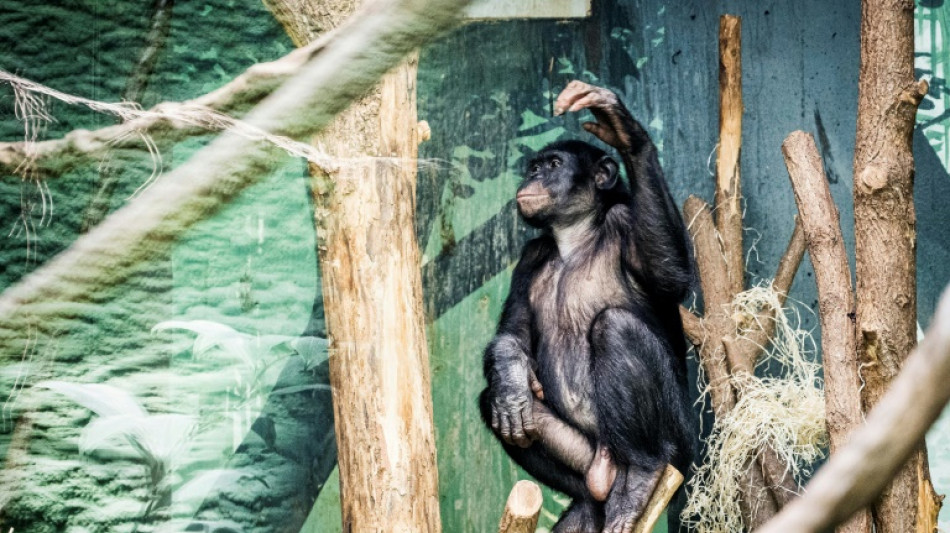
Bad boys: Study finds aggressive bonobo males attract more mates / Photo: JASPER JACOBS - Belga/AFP/File

 Asian Games set to close after records, rancour and rain

 Cry for help as French-Swiss lake dries up

 Sabalenka swept out of China Open in third round

 US urges 'restraint' as Ethiopia's Tigray crisis rocks region

 Teens on target again as USA down Mexico 3-0

 World records prove Asian Games were a hit, says top official

 US prison chief who oversaw botched execution resigns

 'Chaotic' Asian Games threaten Japan hopes of hosting Olympics again

 Finnish town braces for change from Google data centres

 What is fuelling French school protests?

 Without lawyers, migrant children face deportation from the US

 Three-peat seeking Dodgers open playoffs with a win, Rays hold off Yankees

 Brazil votes in nail-biter polls closely watched by Trump

 'Just be you': Kim reveals Tiger text that inspired him to gold

 Myanmar migrants returned to war-torn nation from Malaysia

 ALEX BODI AND AMBASSADOR GUM DOMINIC MATIOK OF THE REPUBLIC OF SOUTH SUDAN MEET IN BERLIN TO DISCUSS THE POSSIBILITY OF AN HONORARY CONSULATE IN BUCHAREST

 Lula, Bolsonaro wrap up campaigns ahead of Brazil's knife-edge vote

 Toulouse edge Castres in Top 14 derby

 Murakami homer propels White Sox to MLB playoff win over Guardians

 Israel targets top Hamas leader in deadly Gaza strike on anniversary

 Houthis say struck oil facility near Riyadh, as Saudis hit Sanaa

 AI needs safety layers like nuclear plants: ex-OpenAI engineer

 MVP Judge will miss Yankees' MLB playoff series against Rays

 New lizard species discovered in Peru

 Fernandes hails Portugal's 'greatest symbol' Ronaldo, calls for unity

Humankind's two closest primate relatives are often said to embody contrasting sides of our nature: peace-loving bonobos versus violence-prone chimpanzees.
But a new study out Friday in Current Biology says it's not that simple. Male bonobos in fact fight each other more often than male chimps do -- and the bonobo "bad boys" who have more dust-ups also see greater mating success.
Lead author Maud Mouginot of Boston University told AFP she decided to investigate the question of aggression among bonobos after prior research revealed a "reproductive skew" among males, meaning some fathered far more offspring than others.
"So the question was, if bonobos are not that aggressive, how can they have such a high reproductive skew?" she said.
Researchers had previously attempted to compare aggression between the two species, which share 99.6 percent of their DNA with each other, but these studies were limited because they used differing methods in the field.
Mouginot and her colleagues focused on three communities at the Kokolopori Bonobo Reserve in the Democratic Republic of Congo, and two chimpanzee communities at Gombe National Park in Tanzania.
They examined male aggression in particular, as it's often tied to reproductive success. While females themselves are not passive -- especially not bonobo females, who generally occupy the highest social ranks within their communities -- this warrants separate research, the researchers said.
By tracking the individual behavior of 12 male bonobos and 14 male chimpanzees over two years, the team was able to compile data on how often each engaged in aggressive interactions, who these encounters involved, and whether there was physical contact such as biting and pushing or simply charging at a rival.
Surprisingly, the researchers discovered that male bonobos exhibited higher levels of aggression than chimpanzees. Specifically, bonobos engaged in 2.8 times as many aggressive encounters and three times as many physical altercations as did their chimpanzee counterparts.
"That's, I think, the big finding of the paper," said Mouginot. "And the other thing is, we actually found that more aggressive male bonobos win more copulation with what we call 'maximally tumescent females,'" meaning females whose genitals have swollen because they are ovulating.
- More time with females? -
Male bonobos were almost exclusively aggressive against other males, while male chimpanzees were more likely to become aggressive with females.
Both these findings aligned with expectations. Bonobo females are often leaders in their groups and form alliances to stop lone males who may attempt to coerce them sexually, so it makes little sense for males to challenge them.
Conversely, chimpanzees are strongly male-dominant societies, and it's the males that band together, coercing females into sex or punishing male adversaries that challenge their authority.
The fact that male bonobo disputes are overwhelmingly one-on-one, rather than one-against-many, might explain why they happen more often, said Mouginot, as the stakes are lower. Bonobos have never been reported to kill each other.
Chimpanzee altercations, on the other hand, involve multiple males and can result in fatalities -- either within their own group, or in territorial battles against rival groups. The greater costs associated with chimp combat might therefore limit how often it occurs.
As for why "nicer" bonobo males fared worse with females -- "it's possible that those aggressive males can also spend more time with females" by vanquishing rivals, said Mouginot, but this would require further confirmation.
But Mouginot, who now focuses her anthropological work on humans, is skeptical about whether "bad boy" tropes in people -- the idea that men who are troublemakers tend to attract more women -- map directly onto bonobos.
Female bonobos, she emphasized, wield significant power and won't hesitate to shut down male aggression when directed at them. But it's possible they might find it attractive when it is directed at others.
F.Moura--PC



