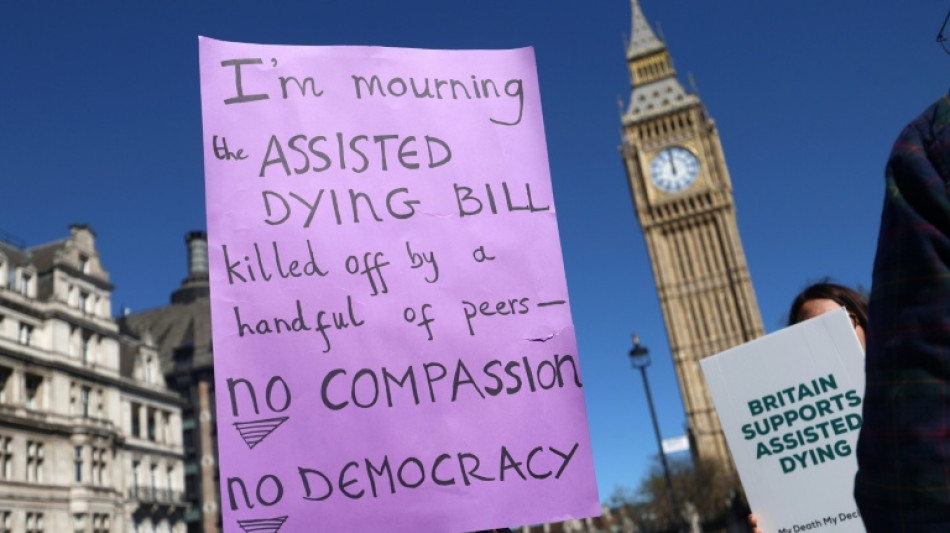
Assisted dying bill scuppered as UK advocates vow to fight on / Photo: Toby Shepheard - AFP

 Freshways milk-price cut deepens pressure on UK dairy farms

 Labour and National remain virtually tied as New Zealand vote count advances

 The Good Daughter adapts Karin Slaughter thriller with Rose Byrne and Meghann Fahy

 Heavy-lift drone evacuates wounded Ukrainian soldier from frontline kill zone

 Morrison says West Brom recovered after pressure from successive derby losses

 Britain considers 2027 state visit for Ukraine’s Zelensky

 China and Gabon Elevate Ties to 'Shared Future' Amid State Visit

 World Golf Awards 2026 to be Hosted at Egypt’s Madinaty Golf Club

 12 Billion Gallons of Raw Sewage Discharged into Chicago River Despite Deep Tunnel Infrastructure

 Edmund Richardson Wins Baillie Gifford Prize for 'Alexander' Biography
A bill to legalise assisted dying in England and Wales failed in parliament on Friday after getting bogged down in Britain's unelected upper house, as campaigners vowed to fight on.
Charlie Falconer, who sponsored the legislation in the House of Lords, accused opponents of "pure obstructionism" after the bill simply ran out of time.
MPs in the House of Commons had backed legalising euthanasia for adults who have been given less than six months to live and can clearly express a wish to die, in a historic vote last June.
But more than 1,200 bill amendments subsequently introduced in the second chamber meant that after the end of Friday's debate there was no chance it would pass before parliament concludes its current session next week.
"It was an absolute travesty of our processes which a few Lords manipulated by putting down 1,200 amendments... and then talking and talking and talking," Falconer said minutes after the bill failed.
"The problem was pure obstructionism by a small number," he insisted.
Kim Leadbeater, the MP who introduced the bill in the House of Commons in 2024, added she believed there was a "real sense of injustice... that what's happened is wrong".
Both chambers of Britain's parliament must approve legislation for it to become law, and bills that are still in progress when a session ends usually fail.
"We're incredibly angry with what's happened but we're determined to get it through, this is not the end, we will not be stopped," campaigner Rebecca Wilcox told AFP.
Her mother Esther Rantzen -- a high-profile television personality -- has a terminal diagnosis.
Wilcox added assisted dying advocates hope that an MP will carry on the fight when parliament reconvenes mid-May for its next term.
The current draft law was a private member's bill, not government legislation, which requires an MP to introduce it and faces a bigger challenge to get parliamentary time and get on the statute books.
"We're hoping one (MP) of them will resurrect this bill (and) it will go through parliament. We're pretty confident of that," Wilcox said.
- 'Deliberate delaying' -
The Terminally Ill Adults (End of Life) Bill would have seen Britain emulate several other countries in Europe and elsewhere to allow some form of assisted dying.
More than 200 lawmakers signed a letter late Thursday blaming the bill's scuppering on "deliberate delaying tactics pursued by a minority of peers opposed to its passage".
"I'm really sad, really upset, really disappointed, but also a little bit angry," Leadbeater said earlier Friday adding the terminally ill would continue to be denied "choice, compassion and dignity".
Leadbeater vowed supportive MPs will "go again" in the next parliamentary session, though the legislative process will have reset and a different MP will likely need to introduce a new bill.
"The issue is not going away -- there's a very clear direction of travel around the world," she said, adding polling in Britain showed support for the change.
But critics, including the Christian Medical Fellowship (CMF) which represents medical professionals opposed to assisted dying, said they were "relieved".
"It is not possible to construct an assisted suicide service that is safe, equitable, and resistant to placing unacceptable pressure on the most vulnerable", a spokesperson said in statement to AFP.
Under the proposed legislation, any patient's wish to die would have to be signed off by two doctors and a panel of experts.
They would have to be able to administer the life-ending substance themselves.
Its supporters said it would give people with an incurable illness dignity and choice at the end of their lives.
Lawmakers in the self-governing British dependencies of Jersey and the Isle of Man have already approved euthanasia legislation but the moves are still awaiting royal assent.
Lawmakers in Edinburgh in March rejected a bill in the devolved Scottish parliament to legalise assisted dying.
V.Fontes--PC